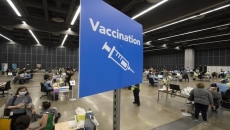
VANCOUVER - Researchers in British Columbia say the expansion of overdose prevention sites in Vancouver led to immediate behaviour changes among some drug users as they entered addiction treatment and decreased the number of times they injected substances in public or shared syringes.
Their study saysthe positive impact of scaling up peer-led supervised injection sites should prompt other provinces and territories to open more such services, which do not need federal approval.
In B.C., the highest rates of fatal overdose are in the urban Vancouver health region, at 44.6 per 100,000 people, and the remote northern region, where the rate is 42.8 per 100,000.
The study, published Thursday in the journal Addiction by researchers with the BC Centre on Substance Use and the University of British Columbia, suggests more overdose prevention sites could reduce deaths from illicit drugs because users face few barriers andpeers and staff can inject drugs for people, including those with disabilities.
That's in contrast with federally sanctioned sites in Vancouver, where nurses who supervise drug use are not permitted to inject any substances that people bring in with them.
Mary Clare Kennedy, lead author of the study and a research scientist at the BC Centre on Substance Use, said the federal government lifted a blanket ban on that practice last year, allowing facilities to apply for exemptions though there has not been any change in Vancouver.
The study involved interviews with 745 injection drug users between January 2015 and November 2018. They were recruited from two ongoing studies at the centre — one involving those who are HIV-positive and another of people who are HIV-negative — to compare trends before and after overdose prevention sites opened.
The findings showed use of the facilities increased by six per cent among the interviewees while participation in addiction treatment rose by nearly five per cent, public injection dropped by about six per cent and sharing of syringes decreased by nearly three per cent.
The prevention sites, which number about 20 in B.C., were considered a temporary measure in response to the overdose crisis, which had the province declare a public health emergency in 2016.
Kennedy said the sites provide a supportive, non-medicalized environment among peers who can help people inject a range of illicit substances, while other modes of use, including inhalation, are also accommodated.
"Approximately a third of people who inject drugs in Vancouver have difficulty injecting themselves and sometimes require assistance," she said. "A number of past studies have shown that this population is much more likely to overdose and to experience violence."
In the current study, 10.6 per cent of participants reported they had overdosed at least once in the last six months, Kennedy said.
"Most studies to date have focused on these highly regulated medical delivery models that are staffed by health professionals, like at Insite," she said, referring to North America's first such facility, which opened in Vancouver's Downtown Eastside in 2003.
"Staff at Insite have never been able to help these people to inject and so they've had no choice but to inject in alleys and in public, which has left them vulnerable to serious harms."
Trey Helten, manager of the Overdose Prevention Society, which operates two of nine overdose prevention sites in Vancouver, said many entrenched drug users avoid Insite because it has an institutional feel and too many rules.
Anyone who passes drugs to another user is banned for 24 hours, along with the person who accepts them, he said.
"As a former drug user, when I was using Insite, I would consider it high-barrier (access)," Helten said, adding other overdose prevention sites have no barriers in comparison.
"We get the worst of the worst, the most problematic people that Insite doesn't want to deal with, that get banned from there. We just allow everyone," he said, adding drug users with an infection would be directed to nearby Insite for care from a nurse.
B.C. has seven federally sanctioned supervised injection sites and 31 others operate in Canada. About 40 overdose prevention sites have opened across the country, but in Ontario, they exist only in London, Toronto and Ottawa though more should be added in smaller communities, Kennedy said.
The latest data from the B.C. Coroners Service show 1,524 people died from Illicit drug toxicity in the first nine months of this year, a rise of 24 per cent over the same period last year.
Yukon's chief coroner said this week that its opioid overdose rate per capita is now the highest in Canada, with 48.4 deaths per 100,000 people.