Opposition parties from across the political spectrum are demanding clarity from the Liberal government on its position on the U.S.-Israel war on Iran as they prepare for a debate in the House of Commons Monday evening.
The Prime Minister's Office has said Mark Carney won't be taking part in a take-note debate about the conflict and its impact on Canadians abroad.
NDP interim leader Don Davies slammed the government's communications on the war so far as "unprincipled, contradictory and incoherent" and said Carney's decision to skip the debate is unacceptable.
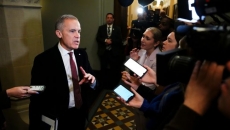
"Canadians deserve to have a clear statement from the prime minister in this House, to be accountable not only to parliamentarians but to the Canadian public, and to clarify what the position of Canada and his Liberal government really is," Davies told reporters Monday.
He added the NDP believes there have been "numerous, repeated and continuing war crimes" in the conflict to date, citing the bombing of hospitals, desalination plants and schools in Iran.
The NDP is calling on the government to clearly state that Canadian troops and resources will not be used "in the prosecution of this illegal war," Davies said.
In Australia last Wednesday, Carney said that while the prospect of Canadian participation in the conflict was a "fundamental hypothetical," he could not "categorically rule out participation," especially if allies call for help.
Defence chief Gen. Jennie Carignan said Friday that she was in discussions with European military leaders about possibly providing support to countries in the Persian Gulf defending themselves from Iranian attacks.
Carney has come in for criticism over a series of shifting statements he has made about the war since the U.S. and Israel attacked Iran on Feb. 28.
Some of his own Liberal caucus members publicly expressed unease after he released a statement in support of the airstrikes the day they began.
Carney stepped back from that position days later by stating the airstrikes likely violate international law, insisting he expressed support for the mission "with regret" and calling for a diplomatic end to the conflict.
Conservative Leader Pierre Poilievre said no one understands Canada's position on the war and accused the prime minister of hiding from Monday's debate.
"The prime minister has taken four different positions on war in the Middle East in four days," he said.
Poilievre condemned the Iranian regime as illegal and said his party supports U.S. and Israeli efforts to overturn it and replace it with a democratically elected government.
He said Parliament should be able to assess any request for Canadian participation in the conflict, if there is one, and the government should be focused on what it can control.
"Here at home, this war should not be used as an excuse for higher food and gas prices. We have the energy here at home, we have the food here at home to make life affordable," he said.
The Bloc Québécois echoed calls for clarity from the Liberals on Monday afternoon.
Bloc House leader Christine Normandin said Carney's decision not to participate in the debate follows a pattern her party has observed throughout his first year in office — "a disinterest, at best, for parliamentary work and for answering questions and for accountability."
The Conservatives also have called for an emergency debate on how the conflict is affecting global energy supplies.
"The war in the Middle East has caused an energy scramble," Poilievre said, adding that allies are looking for alternative sources of energy and Canada is not able to provide it.
He called for changes to laws he claimed are preventing Canadian energy from reaching markets in Europe and elsewhere. He called for the termination of the industrial carbon price and the repeal of the West Coast tanker ban.
"I'll work with the prime minister to get these things done," he said.
Poilievre also said the Carney government needs to use the powers it granted itself through the One Canadian Economy Act — the first bill passed by the Liberal government last summer, with the support of the Tories.
The law allows the government to quickly approve major infrastructure projects that are deemed to be in the national interest. A number of proposed projects have been referred to the Major Projects Office.
Picture Courtesy: THE CANADIAN PRESS/Adrian Wyld