The federal government is putting $200 million toward a Canadian-owned launch pad so it can send satellites into orbit without the assistance of other nations or other foreign third parties.
Ottawa is putting the funds toward a 10-year lease on a space launch pad on the East Coast, a key sovereign capability listed in the federal government's new defence industrial strategy.
Canada does not currently have the ability to launch space projects on its own and has relied on the United States to get its satellites into space. The new launch pad is expected to come into operation by the end of this year.
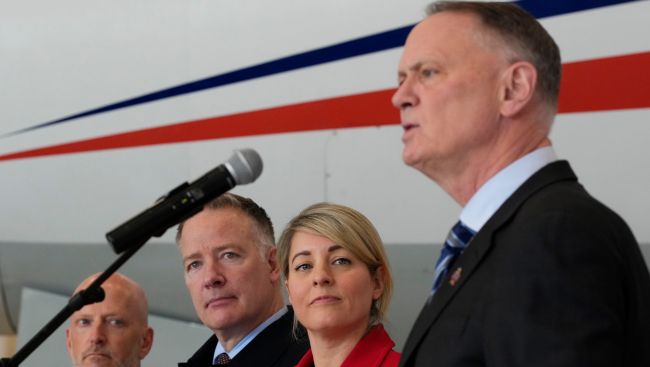
Defence Minister David McGuinty announced the project Monday at a Canadian Space Agency lab in the nation's capital, where researchers use a five-storey-deep vacuum chamber to test satellite technology.
"About 20 per cent of the Canadian economy relies on satellites — our banking systems, our cellphone systems, our transactions," McGuinty said.
"So, we want to be able to give ourself more sovereignty and security on that front."
He added that Ottawa does not want to be entirely dependent on third parties to launch rockets into space, but he did not name any specifically.
McGuinty also announced Canada plans to become a full member of the NATO STARLIFT initiative, a project to create a space-launch network to allow allies to send payloads into space on short notice.
The Halifax-based company Maritime Launch Services, which is building Spaceport Nova Scotia, will set up the site near Canso, Nova Scotia.
Stephen Matier, the publicly traded company's CEO, said the federal contract will give a boost to his company by sending a strong signal to the market about the spaceport's development and by acting almost like an anchor tenant at a mall.
He said a sovereign launch capability is a big step for Canada.
"For years, we've been taking our satellites from MDA Space or Kepler or those here in Canada and writing big cheques to Space X to launch them from Florida or from California," Matier said.
"Space X is selling extra space on their rockets ... but you don't get to go where you want to go or when you want to go."
The announcement comes as the number of spacecraft being put into orbit continues to increase at a dramatic pace.
McGuinty said the world can expect to see up to 70,000 satellites launched into low-earth orbit over the next five years.
David Perry, president of the Canadian Global Affairs Institute think tank, said sovereign launch capacity will help save Canadian satellites from waiting years in a queue for launch.
"You just have way more control over our own destiny. We aren't at the mercy of someone else's priorities and schedules," he said. "So, Canadian national priorities get action quicker than if we're relying on other people's infrastructure."
Sarah Gallagher, former adviser to the Canadian Space Agency and now director of Western University's Institute for Earth and Space Exploration, said there are not a lot of countries around the world with sovereign launch capabilities.
"We have our own space assets in outer space, and so being able to access them immediately with resources that we have control over is quite important. The other thing is that having a launch site actually in Nova Scotia is really advantageous," she said.
"The latitude of Nova Scotia can give you access to different kinds of orbits, which is useful depending on what you're what you're trying to do. Obviously we care a lot about the North, and so having a launch site that's at northern latitudes can be used for that."
The new initiative is part of the Liberal government's Defence Industrial Strategy, its blueprint to build up the Canadian Armed Forces and the domestic defence sector.
The 2025 budget also earmarked $183 million over the next three years for establishing sovereign space launch capabilities, though the federal government did not explain anything about what it envisioned when the budget was released last fall.
Picture Courtesy: THE CANADIAN PRESS/Justin Tang