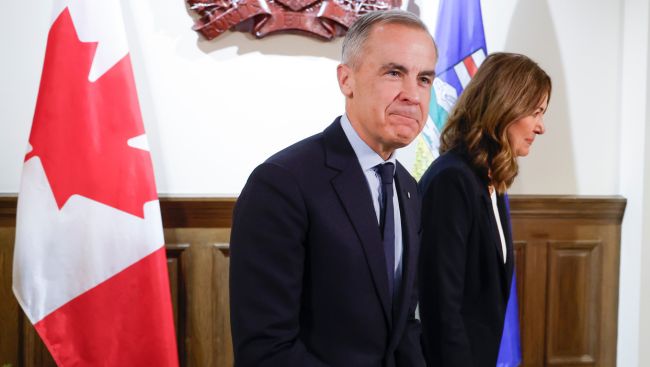
A new pipeline agreement between Alberta and Ottawa could trigger a race to the bottom on Canada's climate policies, advocates said Thursday, as they warned the deal would invite other provinces to make copycat demands.
While Thursday's deal saw Alberta agree to strengthen its industrial carbon price, it also came with several carveouts. The deal proposed to extend a timeline for cutting down on highly polluting methane emissions and suspending clean electricity rules — but only for that province.
The head of the Canadian Climate Institute said political carveouts are a short-sighted compromise that will increase emissions of planet-warming gases and invite provinces to ask for their own special treatment.
"That could trigger a race to the bottom," the institute's president, Rick Smith, said in a statement.
There's no pipeline on the table, but Thursday's memorandum of understanding commits both the federal government and the province of Alberta to work toward building one to the West Coast.
Talk of a new pipeline incensed British Columbia's premier, who said he was not part of the discussion, and raised broader questions about how building new oil infrastructure would be compatible with global efforts to transition away from fossil fuels.
It also prompted the resignation from cabinet of Culture Minister Steven Guilbeault, a former environment minister and an architect of several climate policies put forward by former Liberal prime minister Justin Trudeau's government, including the clean electricity regulations.
Prime Minister Mark Carney said the deal would help Canada diversify its exports and strengthen the economy, while also advancing carbon capture projects.
Those projects can help reduce emissions associated with oil production, but they don't cut into the much larger share of emissions that result from downstream oil combustion — to power cars, for example.
There had been expectations earlier this week that Thursday's support for a pipeline would be paired with a reset on climate policy with Alberta. But the deal instead appeared to open the door to province-by-province renegotiation, said Chris Severson-Baker, president of the Pembina Institute, an energy transition think tank.
The agreement included a provision to scrap a proposed emissions cap on the oil and gas industry, which accounts for one-third of the country's greenhouse gas pollution. It also pushed back by five years, to 2035, a proposed 75 per cent cut to Alberta's oil and gas industry methane emissions.
And the MOU would see Alberta exempted from clean electricity regulations in exchange for strengthening its industrial carbon price.
"It is now very unclear how Alberta will avoid locking in an expensive, outdated, high-emitting electricity grid that will limit its economic potential and keep bills high for Albertans," said Severson-Baker.
The clean electricity regulations, which are to come into effect in 2035, would set limits on emissions from power generation using fossil fuels.
Alberta, with a grid that is predominantly powered by natural gas and keen on boosting investment in energy-hungry data centres, has long been critical of the regulations.
But that province is not alone, underlining concerns about copycat demands that could come from other provinces, including Saskatchewan and Ontario.
Premier Doug Ford said Thursday he was hopeful Ontario would get the same exemption as Alberta.
"Hopefully we get treated fairly across the board," he said.
While the proposed concessions on methane and clean electricity regulations were widely panned in climate circles, many groups paired that skepticism with support for Alberta's commitment to boost its industrial carbon price.
Alberta, which previously said it would freeze the price at $95 per tonne next year, now says it will eventually ramp that up to $130.
There's no timeline for that ramp-up, and no guarantee that Alberta will match the federal government's target of $170 per tonne by 2030. The MOU targeted April 1 for a carbon price deal.
Industrial carbon prices have been shown to be among the most effective emissions reductions policies because they incentivize companies to cut emissions while giving low-carbon companies a boost. Companies that emit above a benchmark can either pay the carbon price or buy credits from those who stay below it.
But Alberta's carbon market has slumped. Credits were trading at around $25 earlier this year, well below a $95 benchmark, S&P Global reported. Companies had banked an estimated three years' worth of carbon credits, collapsing demand for new credits and weakening the incentive to cut emissions, the financial research firm said.
Picture Courtesy: THE CANADIAN PRESS/Jeff McIntosh