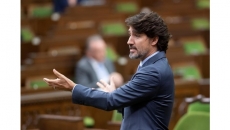
Prime Minister Justin Trudeau says Ottawa is moving forward "aggressively" on ensuring a safe drug supply amid an ongoing overdose crisis that's claimed more than 900 lives in B.C. alone this year.
Speaking on CBC Radio in Vancouver, he says his government is basing its approach on science and evidence, looking at the crisis through the lens of health rather than justice.
Trudeau says the government is heeding the advice of top public health officials, including B.C.'s provincial health officer, Dr. Bonnie Henry, and Canada's chief public health officer, Dr. Theresa Tam.
Both doctors have called for increased access to a safe supply of illicit drugs to prevent deaths from toxic substances and extreme concentrations of powerful opioids, such as fentanyl.
Henry continues to call for the decriminalization of small amounts of drugs for personal use and last month Tam made the same suggestion.
Pressed on whether his government would consider that move, Trudeau says a safe supply is the key "and that is what we've moved forward on without having to take the step to decriminalization."
He notes significant investments are still needed in housing, mental health and other support services for people battling addictions and homelessness.
"We know there's more to do, but we are going to do it responsibly and make sure that we are prioritizing the things that are going to make the biggest difference immediately," he says.
Trudeau adds his government has moved forward on supporting safe consumption sites and safe supply options despite push back from political rivals.
He's spending much of Wednesday in meetings with political, business, environmental and academic leaders in B.C. and he'll do a similar virtual tour of the Atlantic provinces on Thursday.
The summer is usually an opportunity for the prime minister and other federal political leaders to travel widely and engage in outreach with community leaders and voters outside the Ottawa bubble.
Among other things, Trudeau usually convenes a cabinet retreat and attends a Liberal caucus retreat outside the nation's capital each year before Parliament resumes in the fall. He, his ministers and Liberal MPs use those events to fan out into the host communities, listening to local concerns, making some announcements and generally promoting the government's message.
But the need to curb the spread of COVID-19 has put the kibosh on much of that in-person travel this year. Apart from the occasional trip to Toronto, Montreal and communities near Ottawa, Trudeau has been forced to stay home — and find other ways to conduct regional outreach.
Newly minted Conservative Leader Erin O'Toole was similarly forced to figure out other ways to woo supporters across the country during his party's months-long leadership contest.
What political leaders have learned about pandemic-era campaigning and outreach could be useful should Trudeau's minority government be defeated on the throne speech he intends to unveil on Sept. 23, detailing what he has promised will be a bold plan for economic recovery.
Trudeau's virtual tours of B.C. and the Atlantic provinces are at least in part devoted to consultations on that recovery plan.
In addition to a meeting today with B.C. Premier John Horgan, Trudeau is scheduled to hold a roundtable with the province's business and environmental leaders on the measures needed to ensure a green, sustainable economic recovery.
Participants in the roundtable are to include Merran Smith, executive director of Clean Energy Canada; Greg D'Avignon, president of the B.C. Business Council; Carol Anne Hilton, founder and CEO of the Indigenomics Institute; Darcy Dobell, chair of Ocean Networks Canada; Christine Bergeron, interim president and CEO of Vancity; Mark Jaccard, sustainable energy professor at Simon Fraser University; and Kevin Desmond, CEO of TransLink.
Trudeau is also scheduled to meet virtually with University of British Columbia faculty members and private sector partners who've been working on federally funded projects to help support to transition back to work and innovative production of personal protective equipment.