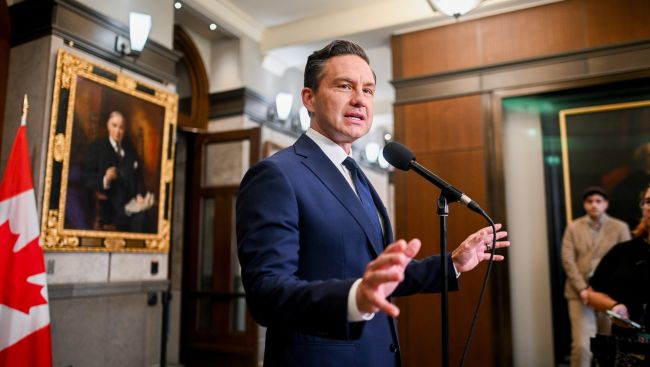
Conservative Leader Pierre Poilievre on Wednesday accused the federal Liberals of allowing temporary foreign workers to take jobs away from young Canadians while youth unemployment is high.
"As our young people have a quarter-century high in their unemployment, Mark Carney this year is expected to bring in a record number of temporary foreign workers to take the jobs of Canadian youth," Poilievre said.
Statistics Canada data shows unemployment for youth, aged 15 to 24, hit 14.6 per cent in July. This is the highest it's been since 2010, outside of the COVID-19 pandemic.
His latest comment on immigration, coming at a news conference in Prince Edward Island, came a few days after the government released immigration data for the first half of 2025. Poilievre says the data showed government is overshooting the targets it set for foreign worker visas, an allegation the immigration department dismissed as untrue.
Last year Canada put limits on how many temporary foreign workers it will admit, the first time the government made such a move, as it grappled with a housing affordability crisis driven in part by rapid population growth.
The federal data shows Canada set a target to admit 82,000 new arrivals through the Temporary Foreign Worker Program this year. Poilievre said the government's data shows Canada issued 105,000 visas under that program in the first six months of this year, which he says exceeds the government's target.
An immigration department official however said the 105,000 figure includes both new visas and renewals for people already in Canada. They said only 33,722 of that number was for new arrivals, or about 42 per cent of the government's targeted number for the year.
Another 302,000 visas were issued between January and June under the International Mobility Program, also including both new and renewed visas. Canada's target for that program was 286,000 new arrivals in 2025.
Between the two programs, the overall target is to admit about 368,000 temporary workers in 2025, falling to roughly 211,000 next year.
Both programs are for temporary foreign workers, but the International Mobility Program allows eligible people to come to Canada and work without the employer having to fill out a Labour Market Impact Assessment to show they couldn't find a Canadian to fill that job. People eligible for the International Mobility Program are allowed under certain free trade agreements or they bring an economic, cultural or competitive advantage to Canada."
A spokeswoman for Immigration Minister Lena Diab said there was a significant drop in the number of temporary foreign workers arriving in Canada in the first six months of this year, falling to 119,000 from more than 245,000 in 2024.
Conservative strategist Kate Harrison, the vice-chair at Summa Strategies, said Poilievre's overall stance on immigration hasn't changed since the election but it has become louder.
"So I think what the Conservatives are looking to highlight here is yet another commitment or an expectation that the government had made around TFWs, around immigration, which increasingly is becoming a priority concern for Canadians," Harrison said.
John Shields, a political science professor at Toronto Metropolitan University, said it's not surprising to see Poilievre putting a greater focus on immigration as it's a bit of an "Achilles heel" for the Liberal government.
"Opinion polls have, over the last two years anyway, shifted quite a bit where there's more resistance or more of a sense that we're bringing in too many immigrants," Shields said.
Former prime minister Justin Trudeau did link high levels of immigration to issues like affordability and the housing crisis near the end of his term, Shields added.
Even with recent planned reductions, targets for temporary and permanent immigration are higher than historic norms. Shields said this will need to continue to ensure a healthy economy because Canada's birthrate is below replacement levels.
"Virtually all of labour market growth is tied to immigration now. So, if we want to renew the labour force and we want to renew the population, and grow the population — you're going to have maintain fairly high levels of immigration," he said.
Poilievre has said the Conservatives will propose reforms to the immigration system.
Harrison said this could be an open lane for the Conservatives to contrast their approach to that of the Carney government, which she said has been more focused on international affairs, like Canada-U.S. relations and increasing ties with Europe.
"I think that leaves a major opening for the Conservatives and Mr. Poilievre to really drive the narrative and drive contrast on domestic policy including immigration, including housing, affordability and crime; like those four things in particular," she said.
The updated immigration levels plan is expected to be released this fall.
The current goal is to get temporary residents down to five per cent of Canada's total population. The proportion of non-permanent residents in Canada is 7.1 per cent of the population as of April 1.
Picture Courtesy: THE CANADIAN PRESS/Spencer Colby