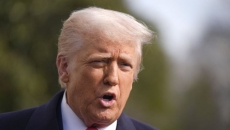
Canadians are showing a lot of enthusiasm for retaliation against the U.S. over President Donald Trump's tariffs — even as many of them fear that the country has slid into a recession already.
A new Leger poll suggests a majority of Canadians — 67 per cent — are in favour of "dollar-for-dollar" retaliatory tariffs, and a third of them strongly endorse retaliation.
But Canada has largely sought to de-escalate and to limit the economic damage from Trump's trade war with much of the world.
"Even though the sentiment is … let's do something back, I think the reality has struck the decision makers in government to say, 'Let's go a little bit more measured and let's dilute it,'" said Tony Stillo, head economist for Canada at Oxford Economics.
A new report from his organization suggests that Ottawa's counter-tariffs currently amount to next to nothing.
Oxford Economics estimates the six-month exemption Ottawa announced for counter-tariffs on the U.S. back in April applies to roughly 97 per cent of the $60 billion in targeted U.S. goods.
That means Canada's not really punching back until October at the earliest.
"I think that it's strategic," Stillo said. "They think they can still negotiate the (Canada-United States-Mexico Agreement).
"And let's face it … it's going to hurt us more than it's going to hurt the U.S. because the dependency of the U.S. on the Canadian economy is a lot smaller than vice versa."
He compared counter-tariffs to the previous Liberal government's carbon tax — a popular measure when it was introduced that triggered a backlash after it increased.
"Sounds good in principle. When you actually are the one having to pay it, all of a sudden, the rubber hits the road," he said.
Leger's tracking of public support for retaliation also shows a mild cooling-off. Support for bloodying the Americans' noses through counter-tariffs has dipped by 10 points since February 25.
"We've seen a softening of that," said Steve Mossop, executive vice president for Western Canada at Leger. "At the end of February it was super high, close to 80 per cent. We see this steady deterioration of that support. So Canadians are — even though that support number is high — there is a sense of, 'Oh, is that really the best approach?'"
Nearly all Canadians fear the U.S. tariffs will hurt their personal finances, with a quarter saying the tariffs will have a major impact.
The polling suggests support for shunning American goods at stores remains strong, at nearly 70 per cent.
"It's as strong as it ever — avoiding purchases, avoiding travel, really taking it to their wallets by punishing the U.S. for their actions," Mossop said.
And the poll says nearly half of Canadians think Prime Minister Mark Carney "stood up" for Canada in his recent face-to-face meeting with Trump — suggesting he passed his first big test as prime minister.
The Leger poll found 48 per cent of poll respondents think Carney "clearly stood up for Canada's interests" in his meeting with Trump, while another 24 per cent said Carney should have taken a "stronger stance."
Broken down by partisan affiliation, 75 per cent of Liberals said he stood up to Trump while 48 per cent of Conservatives said he should have been tougher.
Leger found Canadians paid unusually close attention to the Carney-Trump meeting. It suggests 80 per cent of Canadians said they watched, read or heard about the first in-person meeting between the two world leaders on May 6.
During that meeting, Carney publicly rejected Trump's calls for Canada to become part of the United States.
A plurality of 40 per cent told Leger they believe the meeting had no impact on bilateral relations, while a quarter said the meeting likely improved the Canada-U.S. relationship. Another 13 per cent said they believe it actually made the relationship worse.
Among Conservative supporters, 12 per cent told Leger they believe the meeting improved relations and 23 per cent said Carney stood up for Canada.
"It's kind of a win that he would garnish the support of that 12 per cent as it is," Mossop added.
The poll, which reached 1,500 Canadians between May 9 and 11, can't be assigned a margin of error because it was conducted online.
Three quarters of respondents said they've noticed consumer prices increase in recent weeks and half said they believe the country is currently in an economic recession.
The Oxford report forecasts that the ongoing trade war will plunge Canada into a recession in the second quarter that will last through the end of the year, resulting in some 120,000 lost jobs.
Stillo said he was "surprised and disappointed" to hear there won't be a federal budget this spring. He said the economic stimulus the Liberals talked about during the election would help buffer the economy.
The polling industry's professional body, the Canadian Research Insights Council, says online surveys cannot be assigned a margin of error because they do not randomly sample the population.
Picture Courtesy: THE CANADIAN PRESS/Adrian Wyld