
Wednesday, May 6, 2026
ADVT 
National

Premier Eby says new markets, reforms will help forestry, but results will take time

Darpan News Desk The Canadian Press, 21 Jan, 2026 10:39 AM
  • Premier Eby says new markets, reforms will help forestry, but results will take time

Premier David Eby says a recent agreement advancing wood construction in China will deliver results for the forestry industry in British Columbia, but also acknowledges that it will take "time, energy and commitment" to create a sustainable industry.

A five-year-agreement between British Columbia's Forests Ministry and the Chinese government signed last week boosts the research, development and promotion of modern wood construction in China, and Eby says it is part of the work that will deliver results for the provincial forestry industry by diversifying markets.

Eby delivered the keynote address at the BC Natural Resources Forum in Prince George, B.C., Tuesday night, and says British Columbia's forestry industry has taken the biggest hit from U.S. tariffs.

A draft of the speech released before the event says punitive tariffs from the U.S. have had devastating effects on the foundational industry of forestry, including mill closures leading to job losses, and communities losing revenue. 

The premier says his government has been fighting on multiple fronts, including tackling what he calls "long-standing structural permitting issues."

He says there are no quick fixes when it comes to permitting, but adds that "reform is overdue" in praising a recent landscape plan for the Nimpkish Valley on Vancouver Island as a milestone.

Eby says the plan has delivered higher harvest levels, predictability for industry and ecological protection bringing together governments, First Nations and industry to manage an area of 1,660 square kilometres near Alert Bay and Port McNeill. 

These results will take time, he says, but "they are real" and "they are the future of a sustainable industry."

He says his recent trade trip to India has also shown him the significance of that country as a market opportunity, which can be realized through minor changes in outreach to furniture makers and high-end homebuilders.

Eby says the work around forestry is "challenging" and "it always feels too slow for the urgency of the threat," but promises that "predictable land access, permit reform, value added investments and new trading relationships" will deliver a better future for forestry.   

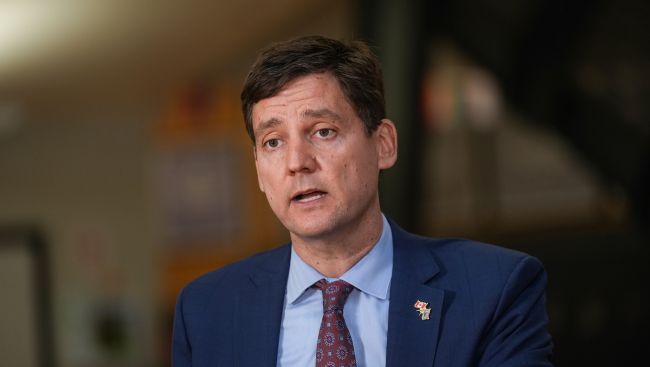
Picture Courtesy: THE CANADIAN PRESS/Darryl Dyck

MORE National ARTICLES

'All bets are off': B.C. pulls liquor, changes procurement after U.S. tariffs

'All bets are off': B.C. pulls liquor, changes procurement after U.S. tariffs
British Columbia Premier David Eby says the province and the country is strong enough to weather the storm in the threat to Canada's sovereignty coming from a former friend. Eby took the unusual step of interrupting B.C.'s budget lockup to address how the province will respond after U.S. President Donald Trump imposed tariffs on Canadian goods.

'All bets are off': B.C. pulls liquor, changes procurement after U.S. tariffs

B.C. budget to buffer province against Trump's 'uncertainty and disorder': minister

B.C. budget to buffer province against Trump's 'uncertainty and disorder': minister
Brenda Bailey's budget is being handed down on the same day that Trump says a 25 per cent U.S. tariff will be placed on Canadian goods, while Canadian energy will face 10 per cent tariffs. Bailey says Trump's tariffs came "completely out of nowhere" when he announced them last November and they've already changed B.C.'s financial circumstances.

B.C. budget to buffer province against Trump's 'uncertainty and disorder': minister

Poilievre says Canadian counter-tariffs should go to fund tax cuts

Poilievre says Canadian counter-tariffs should go to fund tax cuts
Conservative Leader Pierre Poilievre says Canada needs to retaliate against American tariffs by targeting U.S. goods Canada can make, does not need or can obtain elsewhere. Poilievre says Canada needs to cut taxes to counteract the domestic impact of tariffs and points to the carbon price, the capital gains tax and income tax.

Poilievre says Canadian counter-tariffs should go to fund tax cuts

Canadians say they will stop buying U.S. products as Trump’s tariffs take effect

Canadians say they will stop buying U.S. products as Trump’s tariffs take effect
Canadians say they are ready to use their wallets to fight the trade war with the United States, which began today as President Donald Trump imposed 25 per cent tariffs on Canadian goods. Haligonians interviewed today said they are focused on buying Canadian whenever possible, and many said they had already stopped purchasing American products, as Trump had been threatening tariffs for months.

Canadians say they will stop buying U.S. products as Trump’s tariffs take effect

How Canadians are reacting to Donald Trump's tariffs

How Canadians are reacting to Donald Trump's tariffs
Canada is immediately imposing 25 per cent retaliatory tariffs on $30 billion worth of American products, and will expand that to cover another $125 billion in U.S. goods in 21 days. Here’s how political, business and union leaders reacted Tuesday.

How Canadians are reacting to Donald Trump's tariffs

The trade war is on between Canada and the U.S. Here's what you need to know

The trade war is on between Canada and the U.S. Here's what you need to know
A trade war between Canada and its largest trading partner has begun, with tariffs imposed by U.S. President Donald Trump now in effect and Prime Minister Justin Trudeau responding with a package of retaliatory tariffs. Stocks are tumbling, businesses are warning of impending layoffs and further measures from both countries are likely in the coming days.

The trade war is on between Canada and the U.S. Here's what you need to know