
Thursday, May 7, 2026
ADVT 
National

Premiers call for improved relationship with China during trade war with the U.S.

Darpan News Desk The Canadian Press, 23 Jul, 2025 10:49 AM
  • Premiers call for improved relationship with China during trade war with the U.S.

Canada's premiers have called on the federal government to improve the country's relationship with China in the face of the ongoing trade war with the U.S.

With tariffs and constant economic threats from U.S. President Donald Trump, Saskatchewan Premier Scott Moe and Ontario Premier Doug Ford say the country will need to deal more with China.

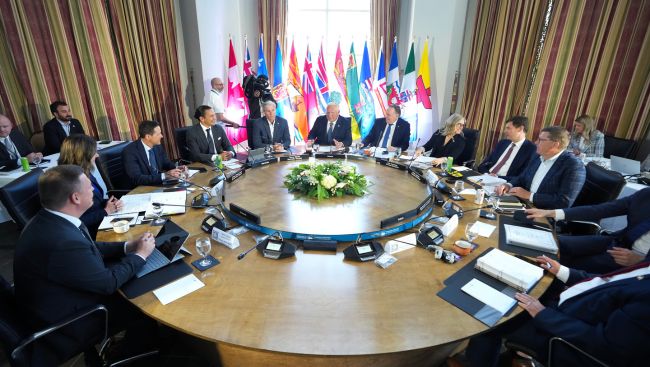
The premiers have gathered in Huntsville, Ont., for the third and final day of the Council of the Federation meeting.

"If we're truly going to move and expand our reliance away from the United States in any way, shape, or form — and I would suggest the only way to do it is on additional products produced, not existing — we're going to have to deal with China, and so we're going to need a broader relationship with them," Moe said.

Both Moe and Ford are worried about steelworkers in their respective provinces, with three major steel plants feeling the brunt of U.S. tariffs on steel, combined with China dumping steel into the market through proxy countries. 

"You know what Churchill said, our enemy of our enemy is our friend, and I don't consider Americans the enemy, but right now President Trump himself is acting like the enemy," Ford said.

He said Ontario imports about $40 billion worth of Chinese goods and exports about $3 billion.

"As long as China plays fair and doesn't undercut our markets, be it the auto sector or any sector," he said. 

"I have no problem dealing with them because we're already dealing with them."

Ford said he still supports the 100 per cent tariffs Canada imposed on Chinese-made electric vehicles last October, matching what the Biden administration had already done in the U.S., as well as 25 per cent tariffs on Chinese steel and aluminum.

Later in the fall, Canada imposed tariffs on a range of other Chinese goods, including EV batteries and parts, critical minerals, solar panels and semiconductors.

In response, China imposed 100 per cent tariffs on imports of Canadian canola oil and meal. It also has a 25 per cent levy on some pork, fish and seafood products from Canada.

Last week, Prime Minister Mark Carney announced a second round of protectionist and anti-dumping measures in response to the U.S. tariffs on steel and aluminum, targeting Chinese-made steel. Canada will raise the tariffs on Chinese steel and aluminum imports to 50 per cent and is adding a 25 per cent tariff on steel melted and poured in China, no matter where it comes from.

The premiers said in a statement they'd like the federal government to prioritize work toward the removal of Chinese tariffs on Canadian canola, peas, pork and seafood. 

They are also asking the federal government for changes to the bail system and more money for health care.

The premiers met with Carney on Tuesday to discuss the trade war with the U.S. after meeting with First Nation leaders the previous day.

The prime minister and the premiers presented a united front in the face of U.S. tariffs, but revealed little about the negotiations with an Aug. 1 deadline fast approaching.

The prime minister and the premiers all downplayed the importance of getting a deal done soon to avoid further U.S. tariffs, saying they want the best deal possible regardless of timing.

A number of provinces also signed several free-trade deals to open up internal trade, while others committed to building pipelines to get oil and gas to new markets.

The premiers are holding a closing press conference this afternoon. 

Picture Courtesy: THE CANADIAN PRESS/Nathan Denette

MORE National ARTICLES

A short list of some of the U.S. goods to be hit with Canadian tariffs on Tuesday

A short list of some of the U.S. goods to be hit with Canadian tariffs on Tuesday
Effective Tuesday, Canada is imposing 25 per cent tariffs on $30 billion in goods originating in the United States — part of Canada's response to sweeping tariffs on Canadian goods ordered by U.S. President Donald Trump. Here are some of the major categories of imported items being hit with Canadian tariffs, along with their approximate annual dollar values:

A short list of some of the U.S. goods to be hit with Canadian tariffs on Tuesday

Ontario, Quebec and B.C. among provinces pulling U.S. booze from provincial retailers

Ontario, Quebec and B.C. among provinces pulling U.S. booze from provincial retailers
Canadian alcohol producers are cheering decisions from several provinces to yank U.S. booze from provincial liquor stores. They say the move will deliver a boost to homegrown business while adding ammunition to a federal plan aimed at getting the U.S. to back down from tariffs.

Ontario, Quebec and B.C. among provinces pulling U.S. booze from provincial retailers

Canada slaps retaliatory tariffs on hundreds of U.S. goods, outlines response plan

Canada slaps retaliatory tariffs on hundreds of U.S. goods, outlines response plan
Ottawa is imposing 25 per cent tariffs on hundreds of goods originating in the United States — from meat and milk to carpets and curtains — in response to steep new American levies against Canada. A federal official also signalled that Canada will pursue available legal remedies in response to the U.S. breaching its international trade commitments.

Canada slaps retaliatory tariffs on hundreds of U.S. goods, outlines response plan

Employment Outlook 2025: Opportunities and Challenges in BC and Canada

Employment Outlook 2025: Opportunities and Challenges in BC and Canada
The employment landscape in British Columbia (BC) and Canada is undergoing dynamic transformations shaped by economic shifts, evolving labor market demands, and demographic changes. As we move into 2025, a comprehensive outlook reveals both opportunities and challenges for job seekers, particularly for immigrants, underrepresented groups, and youth entering the workforce.  

Employment Outlook 2025: Opportunities and Challenges in BC and Canada

Ottawa defers effective date of capital gains changes to 2026, promises exemptions

Ottawa defers effective date of capital gains changes to 2026, promises exemptions
The federal government says it is deferring the implementation of a hike to the capital gains inclusion rate to next year and plans to introduce new exemptions to ensure most middle-class Canadians do not pay more tax if the rate becomes official. The deferral announced by Finance Minister Dominic LeBlanc on Friday delays the implementation of the change from June 25, 2024 to Jan. 1, 2026.

Ottawa defers effective date of capital gains changes to 2026, promises exemptions

Surrey mayor joins alliance of border communities ahead of possible tariffs

Surrey mayor joins alliance of border communities ahead of possible tariffs
Surrey Mayor Brenda Locke said potential U.S. tariffs would put hundreds of jobs in her community at risk, as she became the latest mayor to join an alliance advocating for Canadian border communities. Locke said Thursday that more than 20 per cent of businesses in Surrey have direct trade ties with the United States amounting to roughly $2.8 billion in cross-border commerce each year.

Surrey mayor joins alliance of border communities ahead of possible tariffs