Sunday, May 3, 2026
ADVT 
National

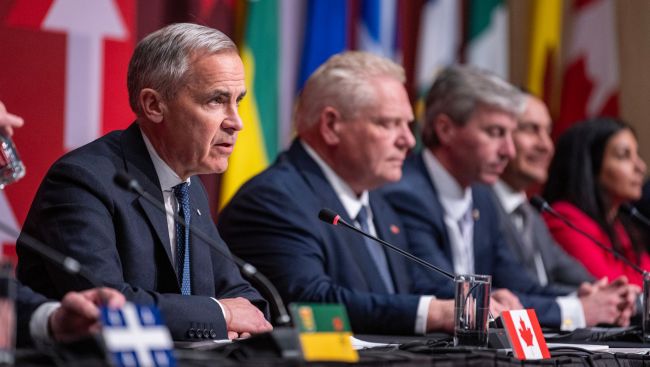
Premiers meet with Indigenous groups on first day of three-day Ontario gathering

Darpan News Desk The Canadian Press, 21 Jul, 2025 10:55 AM
  • Premiers meet with Indigenous groups on first day of three-day Ontario gathering

Canada's premiers are pledging economic reconciliation with Indigenous people as they head into discussions with First Nations, Métis and Inuit groups at a three-day meeting in cottage country north of Toronto.

The premiers have gathered at Deerhurst Resort in Huntsville, Ont., to talk trade and tariffs, particularly when they meet Tuesday with Prime Minister Mark Carney.

But first they are set to have discussions with leaders from the Assembly of First Nations, the Métis National Council and the Native Women's Association of Canada, among other Indigenous groups.

That meeting comes as Indigenous communities have expressed concerns with federal and provincial laws meant to fast-track major infrastructure projects as a way to stimulate the economy facing tariff impacts.

"We think this is a great opportunity for economic reconciliation with First Nations," Alberta Premier Danielle Smith said Monday. 

"We're going to make sure that they prosper like they've never had before and the door is open for them," Ontario Premier Doug Ford said. 

"They're welcome to walk through that door and partner with the entire country and partner with Ontario to make their lives more prosperous than they've ever seen before. That's gonna be their choice."

Smith and Ford said time is tight as the country needs to move fast in the trade war with U.S. President Donald Trump.

But two new laws aimed at stimulating the economy have sparked outrage from many First Nations who want meaningful consultation on major projects in their territories.

The federal law known as Bill C-5 allows cabinet to quickly grant federal approvals for big projects deemed to be in the national interest by sidestepping existing laws, while Ontario's Bill 5 allows its cabinet to suspend provincial and municipal laws through the creation of so-called "special economic zones."

Nine Ontario First Nations have filed a court challenge to the laws.

Carney hosted a meeting with hundreds of First Nations chiefs last week and while some chiefs walked out saying they saw an insufficient response to concerns they'd been raising for weeks, others left the meeting "cautiously optimistic."

Smith said the lengthy regulatory approval process for pipelines and mineral extraction has been a problem and she believes governments can shorten that time frame while also consulting with First Nations.

"I think in this new world that we're in, we have to figure out a way to get to 'yes' faster. It doesn't mean that there isn't a robust consultation that has to happen, but it has to happen in a time frame where a proponent is going to know that the answer is yes and how we get there," she said.

Grand Chief Kyra Wilson of the Assembly of Manitoba Chiefs has asked the prime minister and Manitoba Premier Wab Kinew to formally include First Nations' regional representation at Tuesday's meeting with the premiers and Carney.

"These discussions can’t happen without us. First Nations aren’t just affected by international trade decisions, they are directly involved in the regions, the economies, and the lands these decisions will touch," Wilson said in a statement. 

"We are governing nations with existing mandates and responsibilities. Ignoring that weakens the response and risks repeating the same mistakes we’ve seen for decades."

Ford has said that over the course of their meeting this week, the premiers will also talk about emergency management, energy security, sovereignty and national security, health and public safety. 

Picture Courtesy: THE CANADIAN PRESS/Liam Richards
MORE National ARTICLES

Canada to impose 25% tariffs on $29.8B in U.S. goods starting Thursday

Canada to impose 25% tariffs on $29.8B in U.S. goods starting Thursday
The federal government will impose 25 per cent tariffs on U.S. goods worth $29.8 billion in retaliation for steel and aluminum tariffs the administration of U.S. President Donald Trump imposed today. All countries, including Canada, were hit Wednesday with 25 per cent tariffs on steel and aluminum imports into the United States — part of Trump's attempts to realign global trade.

Canada to impose 25% tariffs on $29.8B in U.S. goods starting Thursday

White House says Trump dropping plan to double steel, aluminum tariffs

White House says Trump dropping plan to double steel, aluminum tariffs
After another chaotic day in Canada-U.S. relations, U.S. President Donald Trump dropped his threat to double tariffs on Canadian steel and aluminum imports after Ontario agreed to pause a surcharge on electricity exports. White House spokesman Kush Desai confirmed a 25 per cent tariff on steel and aluminum, with no exceptions, will go into effect for Canada and all other countries on Wednesday.

White House says Trump dropping plan to double steel, aluminum tariffs

B.C. takes advantage of U.S. 'chaos,' trade war to attract more doctors and nurses

B.C. takes advantage of U.S. 'chaos,' trade war to attract more doctors and nurses
The "chaos" in the United States provides an opportunity for British Columbia to recruit more American doctors and nurses, the province's health minister said as she announced changes aimed at fast-tracking the recognition of their credentials. Josie Osborne said "now is the time" for U.S. health workers to make the move.

B.C. takes advantage of U.S. 'chaos,' trade war to attract more doctors and nurses

Ford says Trump dropping plan to double steel, aluminum tariffs

Ford says Trump dropping plan to double steel, aluminum tariffs
Premier Doug Ford says U.S. Commerce Secretary Howard Lutnick has committed to lowering U.S. President Donald Trump's tariff on Canadian aluminum and steel back to 25 per cent after Ontario agreed to pause a surcharge on electricity exports to the United States.

Ford says Trump dropping plan to double steel, aluminum tariffs

Slower B.C. real estate sales blamed on U.S. tariff uncertainty, association says

Slower B.C. real estate sales blamed on U.S. tariff uncertainty, association says
The British Columbia Real Estate Association says tariff uncertainty has slowed housing activity.  A board report says there were 4,947 residential sales in the province last month, down 9.7 per cent from the same time last year. 

Slower B.C. real estate sales blamed on U.S. tariff uncertainty, association says

Explainer: What's a recession and why is rising anxiety about it roiling markets?

Explainer: What's a recession and why is rising anxiety about it roiling markets?
Stock markets are plunging, consumers and businesses have started to sour on the economy, and economists are marking down their estimates for growth this year, with some even seeing rising odds of a recession. The tech-heavy Nasdaq stock index slipped into a correction last week, defined as a 10% drop from its most recent peak. The broader S&P 500 neared that level Tuesday.

Explainer: What's a recession and why is rising anxiety about it roiling markets?