

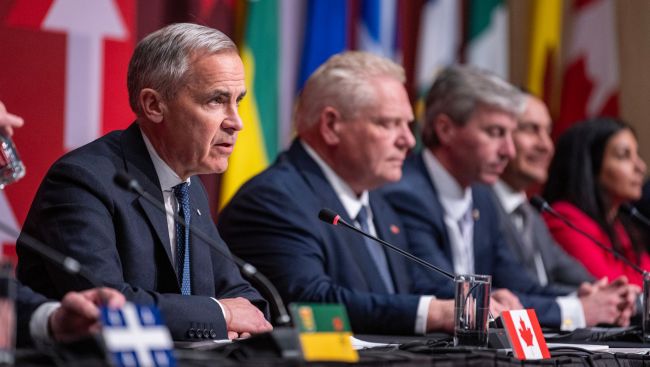
Canada's premiers are pledging economic reconciliation with Indigenous people as they head into discussions with First Nations, Métis and Inuit groups at a three-day meeting in cottage country north of Toronto.
The premiers have gathered at Deerhurst Resort in Huntsville, Ont., to talk trade and tariffs, particularly when they meet Tuesday with Prime Minister Mark Carney.
But first they are set to have discussions with leaders from the Assembly of First Nations, the Métis National Council and the Native Women's Association of Canada, among other Indigenous groups.
That meeting comes as Indigenous communities have expressed concerns with federal and provincial laws meant to fast-track major infrastructure projects as a way to stimulate the economy facing tariff impacts.
"We think this is a great opportunity for economic reconciliation with First Nations," Alberta Premier Danielle Smith said Monday.
"We're going to make sure that they prosper like they've never had before and the door is open for them," Ontario Premier Doug Ford said.
"They're welcome to walk through that door and partner with the entire country and partner with Ontario to make their lives more prosperous than they've ever seen before. That's gonna be their choice."
Smith and Ford said time is tight as the country needs to move fast in the trade war with U.S. President Donald Trump.
But two new laws aimed at stimulating the economy have sparked outrage from many First Nations who want meaningful consultation on major projects in their territories.
The federal law known as Bill C-5 allows cabinet to quickly grant federal approvals for big projects deemed to be in the national interest by sidestepping existing laws, while Ontario's Bill 5 allows its cabinet to suspend provincial and municipal laws through the creation of so-called "special economic zones."
Nine Ontario First Nations have filed a court challenge to the laws.
Carney hosted a meeting with hundreds of First Nations chiefs last week and while some chiefs walked out saying they saw an insufficient response to concerns they'd been raising for weeks, others left the meeting "cautiously optimistic."
Smith said the lengthy regulatory approval process for pipelines and mineral extraction has been a problem and she believes governments can shorten that time frame while also consulting with First Nations.
"I think in this new world that we're in, we have to figure out a way to get to 'yes' faster. It doesn't mean that there isn't a robust consultation that has to happen, but it has to happen in a time frame where a proponent is going to know that the answer is yes and how we get there," she said.
Grand Chief Kyra Wilson of the Assembly of Manitoba Chiefs has asked the prime minister and Manitoba Premier Wab Kinew to formally include First Nations' regional representation at Tuesday's meeting with the premiers and Carney.
"These discussions can’t happen without us. First Nations aren’t just affected by international trade decisions, they are directly involved in the regions, the economies, and the lands these decisions will touch," Wilson said in a statement.
"We are governing nations with existing mandates and responsibilities. Ignoring that weakens the response and risks repeating the same mistakes we’ve seen for decades."
Ford has said that over the course of their meeting this week, the premiers will also talk about emergency management, energy security, sovereignty and national security, health and public safety.
Picture Courtesy: THE CANADIAN PRESS/Liam Richards


