Press passes and television cameras, once powerful symbols of neutrality that helped protect journalists working in combat zones, are providing little defence for reporters and crews covering the escalating urban conflict in the United States.
The U.S. Press Freedom Tracker, an online project sponsored in part by the U.S. Freedom of the Press Foundation and the Committee to Protect Journalists, had documented more than 180 separate incidents since protests erupted late last week in Minneapolis before rapidly spreading to urban centres large and small across the country.
"It's one thing for reporters to get sort of caught in the crossfire, which happens to reporters in hot zones all the time," said Roy Gutterman, a journalism professor and director of the Tully Center for Free Speech at New York's Syracuse University.
On Monday night in Syracuse, a veteran photographer reported being shoved to the ground by an officer who went out of his way to confront him even though he was nowhere near the formation, Gutterman said.
"I think there's been a little bit of a subtle indifference to avoiding shooting into crowds, or just avoiding sending the tear gas or the rubber bullets near where the reporters are huddled."
The protests began in Minneapolis following the death in police custody of George Floyd, a 46-year-old black man who perished with his throat under the knee of a white police officer while being arrested for allegedly trying to use a counterfeit $20 bill. Derek Chauvin has been fired and charged with third-degree murder and manslaughter, but activists want charges against three other officers involved.
One widely shared video clip from Monday night shows riot police using their shields and fists to lash out at an Australian television crew, cameras and microphones in full view, just outside the White House as the police cleared a path through Lafayette Square for President Donald Trump.
Moments later, Trump strolled through the park on his way to a photo-op outside St. John's Episcopal Church. A two-metre fence has since been erected around the park, where protesters were already gathering Tuesday.
Journalism scholars draw a direct line between the behaviour of police and the president's frequent rhetorical attacks on the mainstream media. He's fond of describing his most-hated media outlets as "the enemy of the people," as recently as Sunday calling them "truly bad people with a sick agenda" who are trying to "foment hatred and anarchy."
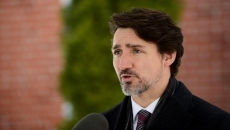
Deputy Prime Minister Chrystia Freeland begged to disagree Tuesday.
"Journalists are not the enemy of the people; journalists serve the people," said Freeland, a former journalist herself who admitted to having been preoccupied by the issue in recent days.
"I cannot say that every single question that I am asked by a journalist is welcome or easy to answer. But I am absolutely convinced that the fact that journalists are present to bear witness, the fact that journalists are present to hold governments to account, makes governments better," she said.
"Freedom of the press is an essential human right and it is an essential element in making democracy strong."
A country that has long portrayed itself as a beacon of democracy is now seized with fury and frustration, punctuated in some quarters by patrol cars and businesses set ablaze, store windows smashed, shops looted and rocks and bricks hurled at heavily armoured lines of riot police.
Police officers in Atlanta have been fired and charged for attacking two black college students in a car; the chief in Louisville, Ky., was fired after officers shot and killed a black restaurant owner with their body cameras off.
"I've never seen anything like it before, and I hope I never see anything like it again," said Arthur Rizer, a former police officer, U.S. Army officer and self-described libertarian who now works for R Street Institute, a Washington think-tank.
The Press Freedom list begins with the dramatic live-on-TV arrest of CNN reporter Omar Jimenez and his crew in the early hours of Friday on the streets of Minneapolis, an incident that later prompted an abject apology and earnest defence of the importance of the press from Minnesota Gov. Tim Walz.
But the rest of the list, covering only five days, details clashes with journalists — some with police, others with protesters, some incidental but others earmarked as targeted attacks — that have left the victims bruised, bloodied and in at least one case blinded after being hit in the face with a pepper ball. Others have been arrested and even jailed overnight.
Frequently, reporters describe refusals by their assailants to stand down even after they have loudly declared their media affiliations and shown their credentials. One Des Moines Register reporter described being pepper-sprayed by an officer in Minneapolis while identifying himself.
Police officers are identified in the Press Freedom report as the alleged perpetrators in 103 of the physical altercations reported to date, not including arrests.
Indiscriminate violence is what happens when urban police officers are allowed and encouraged to behave like army units, said Rizer, an expert on the increasing "militarization" of civilian forces across the U.S.
"Remember, the motto of the police across the country, across the world and in Canada is to protect and serve; that's what they're supposed to be doing," Rizer said. "The motto of the soldier, across the world, is to engage the enemy in close combat and destroy them. And I think when you start blurring those fundamentals together, you end up in a very bad place."
Simple confusion could also be a factor.
"Maybe it's a subconscious trickling down from the 'enemy of the people' lines and some of the other rhetoric," Gutterman said.
"Then again, you know, I've never been a riot police officer. I could only imagine the chaos and emotion that the police are facing, and I'm not sure that the human brain is making the distinction between a group of protesters — who are all holding cameras now — and a group of reporters."
.jpg "Remember us after pandemic: minimum-wage grocery store worker worried about")