

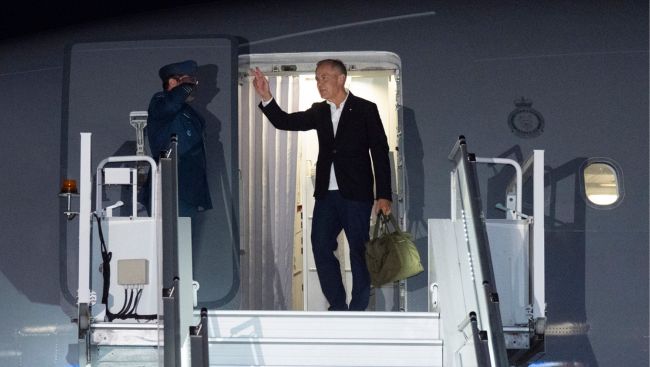
Prime Minister Mark Carney left Canada Friday morning on his first trip to Asia since taking office — part of his government's efforts to build stronger trade and diplomatic ties with a region that's feeling increasingly squeezed between the U.S. and China.
Carney will attend summits of the Association of Southeast Asian Nations, better known as ASEAN, and the Asia-Pacific Economic Cooperation forum, or APEC.
U.S. President Donald Trump is expected to attend both events and world leaders will be vying for his attention.
On Thursday, Trump posted on social media that he was terminating trade talks with Canada over TV ads pushing back on his tariff campaign.
The president was referring to ads airing on multiple American stations — paid for by the Ontario government — that use audio and video of former president Ronald Reagan speaking against tariffs in 1987.
Speaking on the tarmac at the Ottawa airport before taking off Friday morning, Carney said U.S. trade policy is outside Canada's control and he is focused on building up the domestic economy.
He said negotiators "stand ready" for Americans to resume trade talks.
Carney downplayed reports earlier this week that suggested he would meet Trump during his Asia trip to conclude agreements on American sectoral tariffs targeting Canadian steel, aluminum and vehicles.
"I'm looking forward to seeing the president at APEC in Korea, but we're going to be seeing lots of other countries, and you know, one of our core elements of our strategy is diversifying trade," he told reporters in Ottawa on Tuesday.
In a speech made in Ottawa on Wednesday, Carney said his goal is to double Canada's exports to non-U.S. nations over the next decade.
Canada has been pushing for more engagement with the Indo-Pacific region in the last several years, and especially since the launch of its regional strategy in late 2022.
Carney's nine-day trip begins with the ASEAN summit in Malaysia — an event that Canadian prime ministers traditionally have been invited to attend, even though Canada is not a member.
Ottawa is negotiating a trade deal with the 10-nation bloc. The deal originally was set to be finalized this year; both sides are now looking to sign a deal early in the new year. A trade deal with ASEAN member Indonesia was finalized just last month.
Goldy Hyder, president and CEO of the Business Council of Canada, is leading a delegation of Canadian businesses to the region in tandem with Carney's visit.
"In trade, location is everything, and where you are sends a big signal," he said.
"This prime minister has been to Europe five times. The action, in terms of economic growth, is in Asia."
Citing India as an example, Hyder said Canada needs to build economic relationships with other countries that go beyond diplomacy and politics, so that businesses can withstand any turbulence in those relationships over time.
Vina Nadjibulla, vice-president of the Asia Pacific Foundation, said Carney also needs to send a message to potential partners in the region that Canada is interested in more than just trade.
"I think this is an opportunity for Canadians and for the regional partners to hear from Prime Minister Carney his vision for engaging with the Indo-Pacific, how he's intending to deepen trade and economic relations as well as security partnerships," she said.
Analysts say Canada can find common ground with many countries in the Indo-Pacific region on the need to defend the rules-based international order.
"Southeast Asia has been kind of the epicentre of the U.S.-China competition," Nadjibulla said, adding many countries in the region want to avoid being too dependent on either world power.
China has been leading a charm offensive in the region recently, including a tour by President Xi Jinping that came after Trump imposed his "liberation day" tariffs back in the spring.
The ASEAN nations are "really keen to have Japan, Australia, the European Union, India and Canada in the room as strategic partners to engage with the region," Nadjibulla said.
Carney is also set to travel to Singapore, where he has meetings planned with Prime Minister Lawrence Wong and with business leaders.
The final leg of the trip will take him to Gyeongju, South Korea, the city hosting the APEC leaders' meetings.
South Korea was the first Asian nation to sign a free-trade agreement with Canada in 2015.
On Monday, the South Korean embassy in Ottawa indicated it's ready to serve as a gateway to the region when it hosted business and government representatives at an event marking the trade deal's 10th anniversary.
As the embassy's Minister-Counsellor Heijin Kim noted, South Korea fields the world's fifth-largest military — it's been on a war footing for decades — and has a well-developed industrial base that wants to work with Canada.
"Partnering with Korea provides opportunities for cost-effective procurement, technology transfer and joint development," Kim said.
South Korea's Hanwha Ocean is one of two companies bidding for the contract to build Canada's new fleet of submarines. Carney is expected to visit the company's shipyard, about 120 kilometres from Gyeongju, during his trip.
APEC's 21 members are on both sides of the Pacific and include Canada, the U.S., Australia, China, Russia and Peru.
The APEC summit is a forum for bilateral discussions and Xi is expected to attend — leading to speculation that he and Carney may meet in person.
Senior government officials, who briefed reporters about the trip on background, said Thursday that they were hoping and planning for a bilateral meeting.
It is also possible Xi and Carney end up speaking in a less-formal pull-aside, since leaders from Canada and China are often made to sit beside each other in meetings arranged in alphabetical order.
During their meeting in Beijing last week, Foreign Affairs Minister Anita Anand and her Chinese counterpart Wang Yi agreed to revisit a strategic partnership that was developed two decades ago. She also invited Wang to visit Canada.
Western premiers and business leaders have been urging Carney to meet with Xi to resolve the trade issues that have led to steep tariffs in Canada on Chinese electric vehicles and critical minerals, and retaliatory Chinese levies on Canadian canola, pork and seafood products.
Carney said recently that he'll likely meet with Xi "in due course." The Prime Minister's Office said no meeting has been confirmed.
Picture Courtesy: THE CANADIAN PRESS/Christinne Muschi


