

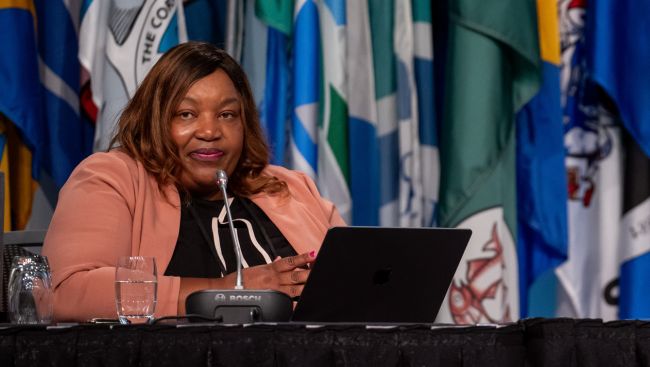
The issues of street disorder, homelessness and mental health will be top of mind when municipal leaders in British Columbia gather in Victoria for their annual convention.
The Union of British Columbia Municipalities president Coun. Trish Mandewo said her members want to see action from the provincial government on those related files.
"It's significant for our members, because we are hearing small businesses and communities all over the province are significantly impacted by the number of people living with mental health (issues) and addictions on our streets," Mandewo said.
The organization represents almost 190 local governments, including municipalities, regional districts, and First Nations and its members meet all week to talk about issues affecting their communities and to lobby higher levels of government for help.
Mandewo, who's a councillor in the Metro Vancouver city of Coquitlam, said local governments are doing "everything possible to provide support" for those living on their streets, 'but the fact is that the province isn't doing enough for supportive, housing, detox and addiction treatments."
The first special resolution put to the delegates and sponsored by the union's executive calls on the provincial government to co-ordinate a "regional approach" to homelessness by "increasing funding and resources for supportive housing and shelter" initiatives across the province.
Delegates will also debate 16 other resolutions from large and small municipalities across the province around similar issues.
The province appointed Dr. Daniel Vigo in 2024 as B.C.'s first chief scientific adviser for psychiatry, toxic drugs and concurrent disorder to help expand involuntary care under the Mental Health Act, then announced the opening of two new secure facilities totalling 28 beds.
The government also announced plans to build more than 400 mental health beds at new and expanded hospitals in B.C. by modernizing 280 outdated beds and adding more than 140 new mental health beds, with more to come.
Mandewo said Vigo will be attending a session to discuss the progress on involuntary care.
"We have a great interest in what he has to say, because last year at our convention, the premier announced that they will be prioritizing involuntary care," she said. "So, our members want to see action, and we want to know where they are at."
Mandewo said local governments have praised the government's approach, but they also want to see more action.
"So, we want to hear what plan there is in order to expand this program," she said.
She said another important topic to be debated and discussed is the recent B.C. Supreme Court ruling that has granted the Cowichan Tribes title to about 7 1/2 square kilometres of land in Richmond, B.C.
Mandewo said the court decision has "tremendous significance" for B.C.'s land title system and UBCM members, adding that this year's conference has invited legal representatives from the Cowichan Tribes, a local government lawyer and a former deputy minister to help fill the information gap.
Another pressing issue is affordable housing and housing supply, she said.
Housing legislation allowing for multiple units on single family lots is driving up the costs of delivering key services, like water, sewer and roads, Mandewo said.
"So, the province's goal of increasing housing supply through their multiple-unit legislation cannot be achieved without a long-term infrastructure plan," she said.
The conference not only features experts from various fields, but also opportunities for municipal officials to meet with ministers and government staff.
Scheduled speakers also include the leaders of all four parties represented in the provincial legislature, with Premier Eby speaking on the conference's last day, Friday, Sept. 26.
Picture Courtesy: THE CANADIAN PRESS/Ethan Cairns


