

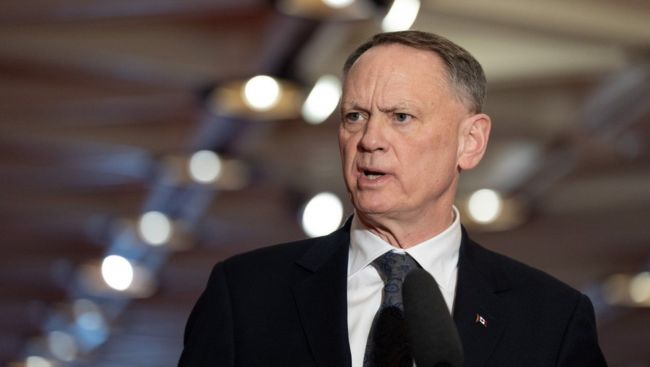
Public Safety Minister David McGuinty said Thursday Canada has acted on U.S. concerns about border security and fentanyl trafficking — even as U.S. President Donald Trump insists economy-wide tariffs will go ahead next week as planned.
"Any test that was put on this country, on Canada, in terms of showing progress and meeting standards for the border — I believe those have been met," McGuinty said outside of the White House.
Canadian law enforcement and border officials joined McGuinty and Canada's newly appointed "fentanyl czar" Kevin Brosseau in the U.S. capital this week to make a final diplomatic push against the tariffs.
Trump's executive order to implement 25 per cent tariffs on all Canadian imports, with a lower 10 per cent levy on energy, was delayed until March 4 after Canada agreed to introduce new security measures at the border.
The president initially tied the duties to the flow of deadly fentanyl but said the pause would allow time to reach a "final economic deal."
In a post on Truth Social Thursday morning, Trump said "drugs are still pouring" in from Canada and Mexico and unless it is "stopped or seriously limited," the tariffs will go into effect "on MARCH FOURTH."
The post came after the president spread confusion Wednesday by suggesting the across-the-board tariffs wouldn't land until April 2 — a statement that was quickly walked back by Commerce Secretary Howard Lutnick and White House officials.
Canada took swift action after Trump issued his tariff threat late last year by introducing a $1.3 billion border plan. Ottawa announced a Canada-U.S. Joint Strike Force to combat organized crime, fentanyl trafficking and money laundering, and deployed additional helicopters and drones along the border.
The RCMP said in a news release Wednesday that a "national sprint" to disrupt fentanyl production and distribution in Canada between Dec. 9 and Jan. 18 resulted in 524 arrests and the seizure of 46 kilograms of fentanyl, along with other drugs, firearms, cash and stolen vehicles.
U.S. Customs and Border Patrol data shows the number of people and drugs crossing illegally into the United States from Canada is minuscule compared to the volume coming across the southern border. It reports just 13.6 grams of fentanyl was seized by northern Border Patrol staff in January.
"The evidence is irrefutable," McGuinty said. "The progress is being made."
Trump said Wednesday it would be "hard to convince" him Canada or Mexico has done enough to avoid the duties.
Canadian officials have made repeated trips to Washington in recent weeks and said they received positive feedback about Canada's actions on the border from Republican lawmakers and members of Trump's team. But it remains unclear what Trump ultimately wants in exchange for dropping his tariff threat for good.
The targets of Trump's complaints about Canada have ranged from defence spending to trade deficits. He has claimed repeatedly that Canada should become a U.S. state.
"We can control what we can control," McGuinty said. "And what we can control is making progress on the border."
Trump's return to the White House has brought with it a massive American tariff agenda targeting Canada and other countries, which could realign global trade and disrupt alliances.
He signed an executive order for 25 per cent tariffs on all steel and aluminum imports into the United States starting March 12. Another order will implement "reciprocal tariffs" on April 2.
Trump signed an executive order Tuesday to look at a levy on copper and has suggested tariffs on automobiles and forest products could land in April.
Saskatchewan Premier Scott Moe said it's important to avoid the "noise and the rhetoric" and remain focused on the larger goal of maintaining North American food and energy security.
"I don't always get along with my family. I don't always get along within our political party or even within our nation," Moe said outside the White House Thursday. "It's important for all of us as North Americans to keep our eye on the long game."
Many experts say Trump's actions are intended to rattle Canada and Mexico ahead of a mandatory review of the continental trade pact. The Canada-U.S.-Mexico agreement was negotiated during the first Trump administration to replace the North American Free Trade Agreement.
Some of premiers have suggested the three countries need to get to the negotiating table quickly to stop the constant tariff threats.
"Sooner we get to that table, the better," Moe said.


