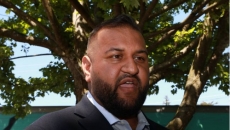
Quebec's immigration minister says the government will drop its permanent immigration targets to as low as 25,000 people per year, and keep them low until Ottawa agrees to slash the number of temporary residents in the province by half.
Jean-François Roberge said Thursday the government will study three scenarios: 25,000, 35,000 and 45,000 permanent immigrants per year.
Currently, Quebec is projected to accept about 64,000 permanent immigrants in 2025, after taking about 60,000 in 2024.
Roberge confirmed that all three potential scenarios represent a reduction in Quebec's immigration target. He said the move was needed because of the high number of temporary residents in the province, which he described as "truly, completely, beyond what is usually expected in classic migration scenarios."
Roberge said the number of temporary residents, which include asylum seekers, international students and temporary foreign workers, has skyrocketed in recent years from 160,000 in 2018 to about 620,000 at present.
He said between 400,000 and 420,000 of those are in the province under programs managed by the federal government, and reiterated a demand for Ottawa to slash their numbers in half, to 200,000, by 2029.
"As long as we haven't reached this ceiling of 200,000 for us, well, there's no way we can consider increasing our permanent residents," Roberge said.
Roberge said he also didn't rule out the possibility of eventually reducing the services offered to asylum seekers if Ottawa doesn't "do its job" in redistributing them to other parts of the country and reducing temporary immigration as a whole.
A recent report by Quebec's statistics agency found the province was home to about 180,000 asylum seekers as of January, accounting for about 40 per cent of the total number in Canada.
"I am simply saying that the status quo isn't sustainable, either for public services or public finances," he said.
The minister said immigration numbers need to go down due to higher unemployment, the strain placed by newcomers on public services and housing prices, and the need to protect the French language.
He said Quebec will also work to decrease temporary immigration in the streams under its own jurisdiction -- though by a far smaller percentage than they're asking of their federal counterparts.
Those measures include decreasing the number of temporary foreign workers to 65,000 from 72,000 over four years, and international students to 110,000 from 128,000. Roberge said the cuts will happen mostly in the Montreal and Laval areas, where unemployment is higher and the French language is most at risk.
Roberge said he wants at least 63 per cent of Quebec's new permanent immigrants to be drawn from the pool of temporary residents who are already in the province, and reiterated the province's aim of eventually having 100 per cent of its economic immigrants being able to speak French.
"It is not a right to demand that you become a citizen here in Quebec," Roberge said. "It's a privilege, but it's a privilege that we want to grant to people who are already here, for the most part, who make an economic, cultural and demographic contribution."
The minister said the government will hold consultations on the changes before announcing its final 2026 to 2029 targets.
Roberge appeared to concede during question period that the lowest proposed permanent immigration target could result in longer waits for family reunification, which are already far longer than elsewhere in Canada.
As an example, the average wait time to sponsor a spouse to come to Quebec is 37 months, compared to 11 elsewhere in Canada.
Roberge said choosing a target means balancing multiple concerns, including youth unemployment, the labour needs of employers, economic development and family concerns.
"There are advantages with the 25,000. You name the disadvantages that are real, we'll debate," he said.
Picture Courtesy: THE CANADIAN PRESS/Jacques Boissinot