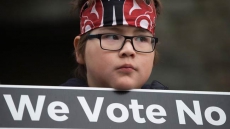
MONTREAL — Advocacy organizations and citizens are denouncing the Quebec government's secularism legislation, saying it turns religious minorities into second-class citizens.
The bill tabled today would ban the wearing of religious symbols for many public sector employees, including teachers, prosecutors, judges and police officers.
Amrit Kaur, a teaching student who wears a Sikh turban, says the bill could ruin her chances of teaching in Quebec's public school system and force her to look for work in a private school.
She says the proposed legislation sends the message that people who wear religious symbols are second-class citizens and that teaching isn't an inclusive profession in Quebec.
Jewish advocacy group B'nai Brith and the National Council of Canadian Muslims have also spoken out against the bill, saying it targets religious minorities and runs counter to fundamental Quebec and Canadian values.
The English Montreal School Board has already said it will refuse to comply with any legislation restricting the wearing of religious symbols.
QuickFacts: Quebec tables secularism bill
Some key elements of Quebec's secularism bill, tabled Thursday by the Coalition Avenir Quebec government.
Who is covered by the prohibition on religious symbols?
Elementary and high school teachers; principals and assistant principals; provincially appointed judges; police officers and peace officers working primarily in Quebec; prison guards; Crown prosecutors; the Speaker of the legislature; members of provincial commissions and boards; ajudicators for tribunals and disciplinary bodies; public inquiry commissioners; arbitrators; the minister of justice and attorney general.
The law won't apply to private school teachers or professors at junior colleges and universities.
What religious symbols are prohibited?
The bill does offers no definition. Immigration, Diversity and Inclusion Minister Simon Jolin-Barrette said symbols of all religions are included, no matter how small or whether they're visible. That includes a cross, kirpan, hijab, turban, kippa or anything similar. Not included are dreadlocks or tattoos of religious symbols.
Who will enforce the rules?
The bill says the "person exercising the highest administrative authority" will make sure employees are in compliance. Jolin-Barrette said the guiding principle for those in authority is that the wearing of religious symbols is forbidden. However there wouldn't be a "strip search to check if the person is wearing a religious sign," he said.
Who is exempt and how many people are affected?
Those who were employed by bodies as of Wednesday and wear a religious symbol will not be required to remove it, as long as they "exercise the same function within the same organization." Jolin-Barrette said the law affects a few hundred people.
When must faces be uncovered?
The law calls on a wide array of public servants to exercise their functions with their face uncovered. Meanwhile, people who want to receive public services "must have their face uncovered where doing so is necessary to allow their identity to be verified or for security reasons."
Where did the government compromise?
The government announced it would support removing the crucifix from the legislature chamber. It also included a grandfather clause covering employees who already wear symbols.
Does it infringe on rights and freedoms?
The bill includes the notwithstanding clause to shield it from constitutional challenges. The clause contained within the Charter of Rights and Freedoms allows authorities to override charter protections for a five-year period.
When will it become law?
Jolin-Barrette said he hopes a final bill can pass before the legislature recesses for the summer on June 15.