Questions are swirling around the fate of the federal New Democrats in British Columbia, including the matter of leadership, after devastating election losses in the formerprovincial stronghold.
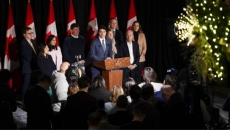
The NDP emerged from Monday's election with only three seats in B.C. after winning 13 in 2021, and none of the winners were committal when asked if they would seek to replace Jagmeet Singh, who lost in Burnaby Central and is stepping down as leader.
Vancouver East's Jenny Kwan says she's focusing on "the work ahead" and what needs to be done in Ottawa and to rebuild support for her party.
Courtenay-Alberni MP Gord Johns — the only incumbent to win on Vancouver Island where the party previously had six of seven ridings — said on election night he needed "time to absorb" and reflect on the results before discussing the party's performance in B.C. and the island.
Don Davies, who eked out a narrow win in Vancouver Kingsway, hasn't returned a call requesting comment on the election.
At least one high-profile B.C. New Democrat has ruled himself out of leadership contention — B.C. Premier David Eby, who says Singh's successor will face a "massive job" to rebuild the party.
Despite the party's hammering in the province, B.C.'s three members still represent the largest provincial faction in the federal NDP caucus of seven.
Kwan, who won her seat by the widest margin among the three surviving NDP incumbents, said they have to focus first on making sure their constituents are heard in Parliament.
"The leadership conversation will unfold in due time, and I'm sure that there will be a process for that," Kwan said. "But for the most immediate moment, what I'm thinking about is the work ahead of me.
"It's not about me. It is about bringing a strong Van-East voice to the House of Commons, fighting for people and making sure that their concerns and their issues are not lost in the process."
B.C. Opposition leader John Rustad of the provincial Conservatives also chimed in on the election results, saying he would like Prime Minister and Liberal Leader Mark Carney to address issues beyond those "from the south," referring to the trade war and annexation talk emanating from U.S. President Donald Trump.
"They need to be addressed obviously, but it is much broader than that," Rustad told reporters.
He said Canada's quality of life had been declining for the last decade, and B.C. had "all this potential" that was being wasted.
Political scientist Prof. David Black said the collapse of the New Democrat vote raised the prospect of a U.S.-style two-party system in Canada.
Nationally, the party's share of the popular vote slumped to 6.3 per cent, down from 17.8 per cent in 2021. The party's vote in B.C. this election was more than double the national share at 13 per cent — but that was a far cry from 2021's 29.3 per cent share.
Black, at the school of communications and culture at Royal Roads University in Victoria, said the possibility of such a "structural realignment" was "one of the most intriguing questions to emerge" from Monday's vote.
Black said while it is possible that voters in Canada may return to the "conventional multi-party system" after the tariff and annexation threats from the United States dissipate, there's also a chance the voting pattern will carry on.
University of British Columbia political scientist Stewart Prest said he didn't believe the vote split in Monday's vote — where the Liberals and the Conservatives combined to take 85 per cent of the popular vote — is a "permanent state."
He says the heightened anxiety likely pushed voters toward the two major parties.
"I think NDP has got its work cut out for it, to take some time off and to step back and reflect on what direction they would like to go under a new leader," Prest said.
"And once they do that, I think they will still be in a position to offer up an alternative that will speak to a subset of the population, because even during this campaign we did hear them speaking about issues that the other two major national parties were not."
Black said there was no way to know yet if it's a permanent restructuring.
"I think, given the recklessness of the Trump White House, I don't think we will know finally until the next presidential election (in the United States)," Black said.
Kwan said party isn't worried about its long-term survival, citing her previous experience as a Vancouver councillor and a provincial legislator under the B.C. New Democrats.
"I've been down that road before," she said. "When I first got elected, I was a party of one in opposition to 10 at city hall … And then provincially, I've also experienced having lost official Opposition status, and I was one of two New Democrats returning to the provincial legislature. So I know what that journey is like.
"One thing I know for sure, regardless, is that New Democrats will be fighting hard for everyday people in the House of Commons. We will make our voice heard and we will make sure that they are not silenced and ignored."
Picture Courtesy: THE CANADIAN PRESS/Darryl Dyck