For many South Asian Canadians, racism no longer feels distant or occasional. It has become louder, more visible, and increasingly normalized, especially online. What often begins as hateful rhetoric on social media now spills into schools, workplaces, streets, and places of worship, leaving communities grappling with fear and exhaustion.
Across Canada, South Asians report a surge in targeted harassment and misinformation, frequently tied to polarizing debates around immigration, housing, and employment. Online, racism appears through coded language and recurring narratives across comment sections and short-form videos. Many posts rely on dietary and hygiene-based stereotypes, portraying South Asians as “dirty” or “unsanitary,” while immigration and invasion rhetoric surfaces in remarks like “go back to where you came from” or claims that South Asians are “invaders.”
Others engage in economic scapegoating, accusing immigrants of stealing jobs or driving housing shortages. Even seemingly unrelated travel or lifestyle content often attracts degrading comments such as “average day in India,” used to mock entire communities.
More recently, AI-generated content has fabricated dystopian “Canada in 2050” scenarios portraying South Asians as a threat, while some online spaces have crossed an even darker line by mocking tragedies or posting explicit threats, depicting how digital platforms continue to amplify hate.
B.C.’s first independent Human Rights Commissioner, Kasari Govender, says the issue cannot be isolated to one cause or one group. “There is no one issue that rises to the top when talking about racism in B.C. today,” she explains. “We are seeing a high number of hate incidents both online and in real life, amplified by the rampant spread of misinformation.”
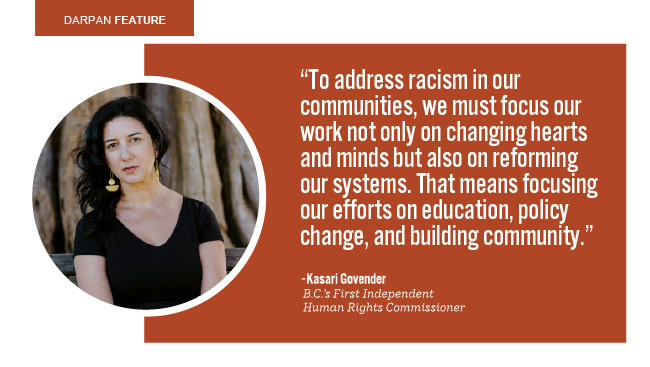
Commissioner Govender warns that focusing only on individual prejudice misses the bigger picture. “To address racism in our communities, we must focus our work not only on changing hearts and minds but also on reforming our systems,” she points out. “That means focusing our efforts on education, policy change, and building community.”
Nationally, the numbers underscore the urgency. According to Statistics Canada, police-reported hate crimes targeting South Asians increased year over year between 2019 and 2024, including a 143 per cent jump between 2019 and 2022. Experts stress that these figures likely underestimate the true scale of the problem, as many victims do not report incidents due to fear, mistrust, or uncertainty about where to turn.
The federal government acknowledges that online hate has become a critical driver of this trend. Amy Mills, Department of Canadian Heritage spokesperson, highlights that the rise in anti–South Asian racism is deeply concerning. “Canadian Heritage is deeply concerned about the rise of racism and online hate targeting South Asians in Canada,” she shares. “Recent analysis shows that anti–South Asian sentiment is increasingly fueled by anxieties around housing and employment, with online platforms amplifying and normalizing these harmful views.”
Research from the Institute for Strategic Dialogue supports this assessment, alluding to a dramatic escalation in hateful content directed at South Asians across major platforms. In response, Ottawa launched Canada’s Action Plan on Combatting Hate in September 2024. “This plan brings together Canadian Heritage and federal partners to strengthen community support, improve data collection, and enhance prevention and response efforts nationwide,” Mills explains. The initiative is backed by $273.6 million over six years, with funding directed toward community security, research, victim support, and public education.
The federal government has also renewed Canada’s Anti-Racism Strategy 2024–2028, reinforcing what Mills describes as a “whole-of-government commitment” to dismantling systemic racism. “Both the Action Plan and the Anti-Racism Strategy aim to build a Canada where everyone—regardless of heritage or background—has a fair chance to belong and participate fully,” she assures.
Legislative tools are also evolving. Proposed amendments under Bill C-9 would make it a criminal offence to obstruct access to places of worship and community centers, criminalize the public display of certain hate symbols, and more clearly define hate-motivated crimes; these steps, as per advocates, are long overdue.
At the provincial level, B.C. has introduced new measures to address both online and offline racism. MLA Amna Shah, parliamentary secretary for anti-racism, reveals that the province is taking a direct and data-driven approach. MLA Shah emphasizes the deep roots South Asians have in Canada. “South Asian Canadians have played a major role in building the province and country we all love,” she reminds. “The recent rise of racism is deeply troubling and unacceptable.”
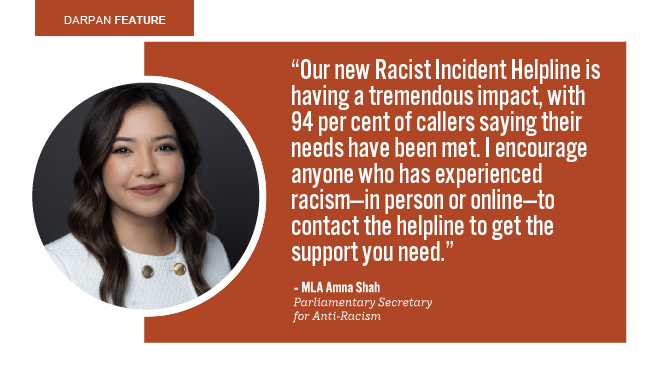
Among the province’s most impactful tools is the Racist Incident Helpline, which provides culturally safe support for people experiencing racism, including cyberbullying. “Our new Racist Incident Helpline is having a tremendous impact, with 94 per cent of callers saying their needs have been met,” MLA Shah notes. “I encourage anyone who has experienced racism—in person or online—to contact the helpline to get the support you need.”
In its first year alone, the helpline received more than 800 calls, including cases involving targeted online harassment. Callers are connected to legal guidance, mental health support, and help document and report abuse to social media platforms. For youth, B.C.’s ERASE program allows students to anonymously report racism and cyberbullying and provides schools with clear response guidelines.
Undoubtedly, while resources are vital, community action matters just as much. For those facing online hate today, the message from authorities is clear:
- Document incidents
- Seek support
- Report abuse
After all, racism thrives in silence but loses power when confronted collectively!