

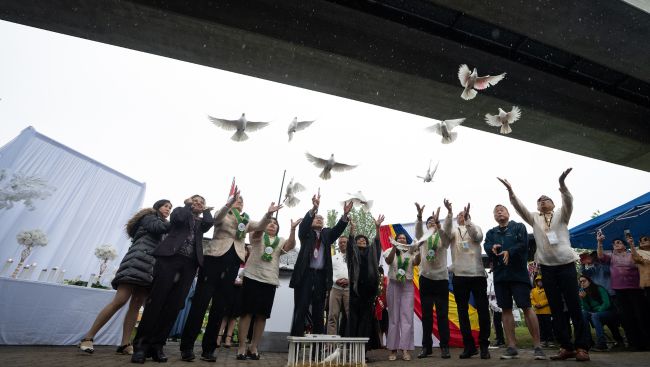
Terry Yung says that when he attends Vancouver's Chinatown Festival this weekend, he'll enjoy himself knowing that the work has been done to make him and other attendees feel safe.
British Columbia's minister of state for community safety said pursuing that sense of security was "the foundation" of a report he released Wednesday making six recommendations on improving safety for community events in the wake of the April 26 attack on Vancouver's Lapu Lapu Day festival, that killed 11 people and injured dozens more.
Yung said the point of the report was "not to look at one moment in time in the past which we cannot change."
"I can't speculate what could or could have happened but what we can do in future to make us all safer," he said.
The report by former B.C. Supreme Court chief justice Christopher Hinkson recommends that all public events, regardless of size, should be supported by a risk assessment, and that a provincial events hub be developed for sharing information and advice.
It also recommends inter-agency co-ordination and more accessible education and planning resources.
Hinkson was appointed in the days after the festival attack by Premier David Eby to "maximize safety," while remembering that people still wanted to be able to get together and celebrate.
Yung said the government fully accepted the intent of the recommendations, but didn't say when they would be implemented.
"We'll move on this as fast as we can," he said.
"It's important to understand, in light of the tragic event, and (it's) easy to be overwhelmed by emotions … the report said the vast majority of public events in this province are safe, they're well organized and they're widely enjoyed."
While some events have access to professional support, the report says many celebrations rely on volunteers with little training or funding, and rather than impose rigid rules, the report says steps need to be taken for consistency and confidence in hosting gatherings.
Adam Kai-Ji Lo has been charged with multiple counts of second-degree murder over the Lapu Lapu festival attack, in which a vehicle sped through a crowded street, and his next court appearance for a fitness hearing is on July 23.
The City of Vancouver and police issued a preliminary report in May, saying planning for the festival appeared to have followed prescribed processes despite not having heavy vehicle barriers in place.
It said police did not recommend higher security and the 2024 festival was deemed a low risk, while police had said previously that only nine of the 3,200 events in Vancouver used heavy vehicle barriers.
Hinkson's report says Vancouver and Surrey have developed sophisticated permitting for special events, alongside comprehensive planning protocols.
"While this system is more elaborate than what might be required in smaller or rural communities, it may offer valuable considerations for other jurisdictions seeking to improve their event safety planning."
Hinkson's report says hostile vehicle attacks aren't the only risk, noting safety concerns over food and water adulteration, and pointing to a music festival in France where 145 people reported being pricked by syringes in January.
The report says there's "a trade-off between ensuring that event attendees are protected from hostile or unintentional vehicle incidents while at the same time allowing special events to continue unabated.”
In the report, Hinkson says he consulted with municipalities, regional districts, Indigenous groups, police, and event organizers, representing a wide range of communities — from large urban centres to remote rural regions.
The report says their consultations found both strengths and vulnerabilities.
"Many communities have built strong working relationships between local governments, first responders, and community organizations to support safe and successful events," the report says.
However, smaller or under-resourced jurisdictions face persistent challenges, including limited staff, rising costs for equipment and security, unclear lines of responsibility, and difficulty navigating overlapping jurisdictions or fragmented guidance, it says.
The Union of B.C. Municipalities said in a statement in June that it provided a submission to the commission asking it to avoid a one-size-fits all framework, since many local governments, especially the smaller ones, struggled with numerous responsibilities and costs could force event cancellations.
Here is a summary for the six recommendations:
Risk assessments and event planning: All public events in British Columbia, regardless of size, should be supported by a risk assessment. A comprehensive risk assessment should consider the event’s scale, location, activities, and potential hazards, including risks to specific groups and environmental factors.
Clarifying jurisdictional roles in event oversight: The province should establish clear criteria for consultation that defines the roles and responsibilities of all parties involved in event planning, approval, and emergency response.
Training for planning support and centralized hub: The province should establish a centralized hub to support event safety across British Columbia. The hub would provide accessible, standardized advice, training, and practical tools for event organizers, municipal officials, and others involved in planning public gatherings.
Support for event delivery and local capacity: Consultations made clear that rising safety and security costs are one of the most significant barriers to hosting community events. For many organizers, particularly in smaller or under-resourced communities, the costs threaten the viability of their events. The province should consider expanding availability of grants or financial support to offset safety and security costs.
Foster local collaboration on event safety: Event organizers in smaller communities would benefit from more focused collaboration with emergency services. Consultation during the planning phase can improve readiness and build trust between interested partners. The province should encourage regular tabletop exercises including police, fire departments, emergency management services, and event organizers.
Promote learning through event evaluation: The province should encourage the routine use of after-action reports and collection of public feedback after events.
Picture Courtesy: THE CANADIAN PRESS/Ethan Cairns


