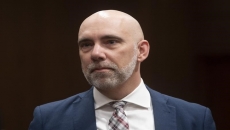
Exactly what president-elect Donald Trump plans to do with tariffs on Canada remains a mystery not just to Canada but to most Republicans, Energy and Natural Resources Minister Jonathan Wilkinson said Thursday.
Wilkinson spent several days in Washington, D.C. this week meeting with Congressional Republicans as Canada tries to limit the damage from Trump's promise to sign an executive order Monday to hit its North American neighbours with 25 per cent across-the-board tariffs on all exports to the United States.
Wilkinson said a very small group of officials is crafting Trump's plans for executive orders.
"Even Republican senators and Congresspeople and others who are quite close to the administration do not have a good read on exactly what the nature of a tariff might look like," Wilkinson told reporters on the final day of his trip Thursday.
Wilkinson met with Republicans Kevin Cramer, Ted Cruz, Bruce Westerman and Chuck Fleischmann, as well as Democrat John Hickenlooper. The minister also had meetings with energy policy experts.
NEW: I interviewed Canada's energy minister today
— Rachel Frazin (@RachelFrazin) January 14, 2025
While Trump is threatening tariffs, Canada's Wilkinson is suggesting a minerals and energy partnership instead pic.twitter.com/fFywafm16k
Wilkinson said he's heard of three options being considered: 25 per cent tariffs, 10 per cent tariffs and a lower duty that ratchets up over time.
The Republican leader initially said the tariffs were being imposed in response to drugs and illegal immigration crossing the shared border.
Ottawa responded with a $1.3 billion package to beef up the border but Trump has since pivoted to citing the United States' trade deficit with Canada.
"In terms of what more he wants, I am not even sure that the president himself ... fully knows exactly what he wants," Wilkinson said. "I think President Trump is somebody who is a proficient negotiator. I think this is about creating leverage."
There's been much debate across Canada on how the country should respond, but Wilkinson said the federal government will need to wait and see.
Minister of Foreign Affairs Mélanie Joly also travelled to Washington this week — the latest minister to make the rounds since Trump made the tariff threat in November.
Information from her office said Joly will meet with government leaders to discuss ways to bolster the bilateral partnership, including on issues of border security, trade and investment, while also reiterating that tariffs will harm the economy of both countries.
Also on Thursday, Prime Minister Justin Trudeau formed a new 18-member Canada-U.S. relations council to support the federal government as it deals with the threat of tariffs.
It comes after Trudeau met with premiers in Ottawa Wednesday and most leaders emerged with a commitment to unity in the response to Trump.
"We have a shared sense of purpose, a shared sense of understanding, and a commitment to stand together on a united path forward," Trudeau said.
Alberta Premier Danielle Smith broke from the pack, refusing to sign a joint statement, saying Alberta will not agree to export tariffs on its energy or other products.
"Nor do we support a ban on exports of these same products. We will take whatever actions are needed to protect the livelihoods of Albertans from such destructive federal policies," Smith said in a statement on social media.
Wilkinson said conflicting messaging from Canadian leadership is causing confusion among American legislators and industry at a time when they need to receive a clear argument from Canada.
He called Smith's Wednesday statement unfortunate and criticized NDP Leader Jagmeet Singh's proposal of tariffing critical mineral exports to the U.S.
Wilkinson said "the NDP leader honestly doesn't know what he's talking about."
"To be honest with you, Mr. Singh is not helping the cause of Canada by saying things like that publicly."