A report commissioned by British Columbia's government says its pursuit of new natural gas projects "threatens to set back progress" in reducing greenhouse emissions and the province is expected to fail its 2030 target.
The independent report into B.C.'s climate action plan, known as CleanBC, says new liquefied natural gas projects promise thousands of jobs and investments worth billions, but also add pollution that "stand to all-but wipe out hard-fought gains in other sectors."
The report released Wednesday points to what it calls "opportunity costs" that come with developing LNG.
It says keeping pollution from the natural gas and LNG sector as low as possible requires "significant electrification," and achieving net-zero emissions would require proponents to "electrify nearly all aspects of their supply chains."
"However, British Columbia does not have a sufficient electricity supply to enable it to do so," it says.
Electrification of the LNG sector would also compete with the needs of other sectors, such as critical mineral mining and the electrification of transportation.
The report casts doubt on the economics of LNG.
A "glut" of LNG expected to persist through 2030 and could push commodity prices to their lowest point since Russia's full-invasion of Ukraine.
"This uncertainty amplifies concerns about the opportunity costs of an aggressive LNG development push," it says.
The provincial government commissioned the report as part of an accord with the B.C. Greens, whose two legislators provide support for the NDP in confidence measures under certain conditions.
Newly-elected party leader Emily Lowan said the report underscores what she called the "fundamental contradiction" in B.C.'s climate plan, namely that "expanding LNG production is incompatible with meeting the province's emission targets."
Green MLA Jeremy Valeriote said the province has gone from "climate leader" to "climate laggards," and the province cannot meet its climate targets while handing out permits expanding fossil fuels.
Valeriote said the report also includes what he called "really positive" elements that will help inform the future of his party's agreement with the NDP.
"So, there are a number of things here that will form a template for things we would like to see going forward and that will be part of the discussion," he said.
Opposition leader John Rustad of the Conservative Party of B.C. said CleanBC has done more damage to the provincial economy than the tariffs of U.S. President Donald Trump.
"We need to get our economy firing on all cylinders, and that means we need to be looking at everything that's an impediment to being able to see investment come to British Columbia," Rustad said.
The report broadly calls for a "renewal" of CleanBC.
"British Columbia is exceptionally well positioned for the clean energy transition," it says.
Advantages include an abundance of critical minerals, low-carbon building materials, and what the report calls "plentiful clean and renewable resources," such as wind, solar, water and geothermal that complement existing hydroelectricity.
Co-authors Merran Smith and Dan Woynillowciz say CleanBC is cutting climate pollution, creating jobs and lowering everyday costs for British Columbia, but is "not yet reaching its full potential" as B.C. will "fall well short" of its 2030 goal to reduce greenhouse emissions by 40 per cent from 2007 levels.
A report released this spring says B.C.'s carbon emissions are expected to instead to drop by 20 per cent by 2030.
Smith said B.C. has a "suite of policies that are good," but needs to do more, as other jurisdictions have matched or exceeded what was once a "world-leading" plan.
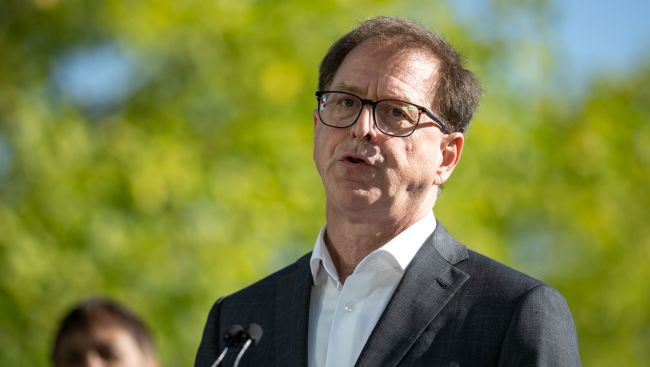
Energy Minister Adrian Dix said his government accepts Smith's criticism, and government agreed to the review because it wants to do better, especially in transportation, where population growth has led to more emissions.
Asked about the LNG projects, Dix said that while it is a fossil fuel, B.C. has taken what he calls "significant steps" to reduce the emissions of new projects by electrifying them.
"It's still natural gas, but compared to LNG projects around the world, not coal, but LNG projects around the world, these are the lowest emission projects," Dix said.
B.C. has also taken steps to reduce the emissions of methane, while acknowledging that more needs to be done, he said.
"So, you've always got to be concerned with the economy, but you will always have to be concerned with the climate action," Dix said. "Sometimes that involves a balance of issues. But I think there are lots of recommendations that show the economic advantage of investing in clean electricity and investing in clean initiatives."
Dix said the government will review the recommendations before next year's budget.
Several voices from the environment sector praised the review, but not without caveats.
The Canadian Climate Institute said in a statement that the review offers a "realistic" path toward strengthening the economy, while cutting emissions.
A statement from West Coast Environmental Law said most of the recommendations will help reduce greenhouse gas emissions. However, it criticized government for reducing its ambitions and expressed concern that future actions will fall short of what is needed, given B.C.'s history of failing to follow through on its goals.
Picture Courtesy: THE CANADIAN PRESS/Ethan Cairns