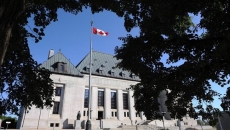
The estates of murder victims Barry and Honey Sherman argued Tuesday in the Supreme Court of Canada that unsealing files related to the wealthy Toronto couple would pose serious safety risks to estate trustees and beneficiaries.
A lawyer for a Toronto Star newspaper reporter seeking access to the files told a seven-judge panel the attempt to keep the material under wraps runs contrary to the principle of open court proceedings.
After hearing arguments, the court reserved its decision, which is expected in coming months.
In June 2018, a judge issued an order protecting the files, which concern the appointment of estate trustees and would ordinarily be available for public inspection.
The order stemmed from the notion that individuals named as beneficiaries or trustees of the estates would be at risk of harm because the Shermans were found murdered in their home.
Soon after, Toronto Star reporter Kevin Donovan, who has written extensively about the sensational case, applied to the Ontario Superior Court of Justice to have the files unsealed.
In August 2018, the court dismissed his application and ordered that the files relating to the Shermans' estates be sealed for two years. The Ontario Court of Appeal overturned the decision, saying the idea trustees would be at risk amounted to speculation and provided no basis for a sealing order.
Barry Sherman was the billionaire chairman and CEO of pharmaceutical firm Apotex Inc. He and his wife were philanthropists and well-known members of Toronto society, sparking intense interest in their deaths and the resulting police investigation. The murders remain unsolved.
In a written submission to the Supreme Court, the Shermans' estates and trustees contend the general public interest in maintaining court openness cannot outweigh the "serious invasion of privacy and grave physical safety risks" posed by disclosure.
Lawyer Chantelle Cseh expanded on those arguments during the hearing Tuesday, saying the Appeal Court erred in deciding that the privacy and dignity of "those left in the wake of violent crime" are purely personal concerns that cannot, without more, justify a sealing order.
"This so-called privacy-plus model adopted by the Court of Appeal is inconsistent with decades of case law and our society's understanding of privacy rights."
Several judges peppered Cseh with questions about the alleged dangers to the beneficiaries and trustees. Justice Russell Brown said the necessary evidence cannot simply be that such individuals are relatives of crime victims.
"It surely has to be more than that," he said. "Otherwise, we're going to have sealing orders on the estates of every person who's a victim of murder."
Cseh stressed the importance of context, saying that requiring "scientific or empirical evidence of the likelihood that somebody will suffer violent crime, or kidnapping for instance in this case, is asking for the impossible."
Justice Michael Moldaver suggested the murders were "a very, very sophisticated crime, in my view, committed by a very sophisticated organization — at least it has those hallmarks."
As a result, he said, the perpetrators would likely already know "who the beneficiaries are, who the children are, who the grandchildren are and everything else about this family."
There was also considerable discussion of whether a publication ban on the contents of the files, as opposed to a full sealing, would be sufficient.
Cseh said a publication ban would still allow any member of the public to obtain the files and learn details about the individuals including names, addresses, birth dates and financial information.
A submission to the top court from counsel for Donovan says that, given the choice, anyone might prefer their individual court matter proceed in private. "Yet it is fundamental that this is not how our system works."
Iris Fischer, a lawyer for the journalist, told the court Tuesday that a risk of harm must be grounded in substance, "some reason to believe that there is a real security risk, and that's not the case here."