Montrealer Marianick Baril says she's had eight flat tires since Christmas. Now, she plans her daily commute less on travel time and more by choosing the streets that have the fewest craters that threaten to send her vehicle back to the mechanic.
This winter has been particularly perilous for Baril and other Montreal drivers, with officials reporting 3,824 pothole-related complaints between Jan. 1-27, nearly five times the 796 logged over the same period last year.
''This isn't normal,'' said an exasperated Baril on the scarred, pockmarked roads that have forced her to spend about $3,500 since late December repairing her 2015 Honda Accord Touring.
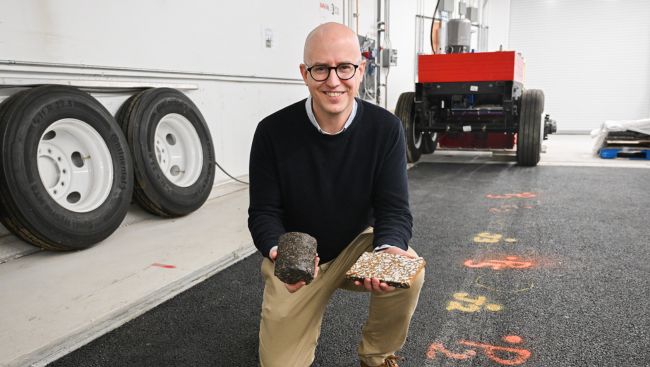
But it doesn't have to be this way. A specialized laboratory at a Montreal technology college is trying to help fix the city's perennial asphalt problems. Its director, engineering Prof. Alan Carter, says he has solutions. The issue, he laments, is a lack of money and political will.
“There’s a question of responsibility that no one wants to take,” he said. “It’s understandable — we don’t have the money.”
Meanwhile, the city is quick to note that this season's weather is partly to blame. Numerous freeze-thaw cycles, particularly in January, have taken their toll. Environment Canada has recorded at least 17 days this winter with temperatures fluctuating above and below zero.
“Water seeps into cracks, freezes, and expands, weakening the road surface,” says Carter, who leads the pavements and bituminous materials laboratory at École de technologie supérieure.
And while he recognizes that Montreal's punishing winters do a number on infrastructure, he says the main reason for the city's disastrous road network is insufficient maintenance. The city has delayed maintenance for so long it doesn't have sufficient labour or money to properly fix the roads in a reasonable time, Carter said. Municipal and provincial government, he added, must start factoring in long-term upkeep when approving infrastructure projects.
“We build (roads), but without enough money for maintenance," Carter said.
Another issue is the recipe behind the asphalt poured into city streets. Carter’s laboratory is developing mixes that he thinks can be better suited for Quebec winters, but he says his innovations aren't making their way to the streets of Montreal.
Using an accelerated loading track — a 12-metre-long, three-metre-wide, and 2.8-metre-deep road surface — his team simulates years of traffic in only months. “We’re trying to optimize the recipe. We need mixes that last as long as possible,” he said.
The laboratory is testing various levels of recycled asphalt pavement — or RAP. The Quebec government has a 20 per cent cap on recycled materials in its asphalt, but Carter is trying to see whether that can be increased without losing performance. He also thinks some less-used roads in Montreal can forgo asphalt altogether and instead be composed of gravel, which he says is cheaper and easier to maintain.
But the Transport Department, he said, "doesn't have any money, so the whole research and development side, and the modification of the standards, and the innovation side, they have almost no staff for that.''
Asked if the Transport Department collaborated with Carter's laboratory, spokesperson Louis-André Bertrand recently told The Canadian Press in an email, “The department has its own pavement laboratory.”
In a statement on Tuesday, another spokesperson for the department said, "given the winter conditions, only urgent — or at best temporary — repairs are possible." Nicolas Vigneault said temperatures must be above 10 C for permanent repairs, adding that "more durable work will be carried out as soon as weather conditions permit."
He said the province has announced total investments of $1.2 billion between 2025-27 "to improve pavement conditions and $1.4 billion to make the network more efficient and safer."
A 2021 CAA-Québec report estimated that poor road conditions cost Quebec motorists $258 annually in vehicle repairs — more than double the national average.
Montreal maintains about 4,030 kilometres of roads, many showing signs of wear. The city's auditor general has said that as of 2024, about 25 per cent of arterial roads were rated poor or very poor, and 37 per cent of local streets were in that category as of 2022. Montreal officials plan to spend about $684 million on roadwork in 2026 — roughly $82 million more than last year, including resurfacing and planning programs.
In 2025, the City of Montreal repaired 103,026 potholes through private sector contracts, up sharply from 61,286 in 2024 and slightly higher than the 98,288 recorded in 2023. These figures exclude repairs carried out by borough governments.
Catherine Lavoie, CEO of a non-profit research centre on urban infrastructure in Montreal, said the deterioration reflects years of underinvestment in maintenance. “I have never seen roads in such poor condition .... It was clear that the previous city council had other priorities. Today, unfortunately, we are seeing the consequences of this.”
But Alan DeSousa, mayor of the Saint-Laurent borough and member of Ensemble Montréal — the party of recently elected Montreal Mayor Soraya Martinez Ferrada — said it would be "too easy to point the finger at the previous administration. I have a responsibility to find solutions.”
In a response to the accusations that the city has under-invested in road maintenance, Martinez Ferrada's office said in a statement, ''We spare no effort to prevent potholes in the long term.''
From October 2024 to mid-January 2026, the city says it poured 19,310 metric tons of asphalt on Montreal streets. Carter says that's enough to pave roughly 27 kilometres of a standard one-lane street, with a thickness of 10 centimetres. He says that's a reasonable amount of asphalt for that time frame, but he insists it's not the lack of asphalt that is causing Montreal's problems.
Many Montreal streets are failing from the bottom up, he said, explaining that too many road foundations are "dead … but we keep plastering the cracks." Roadways are built in layers: a structural base that provides strength and stability, topped by a thinner surface layer designed for traction and safety. Most repairs, Carter said, replace only that upper layer, leaving weakened foundations untouched — a temporary fix to a deeper, structural issue.
The challenge extends beyond Montreal. Nearly half of provincial pavements are rated poor or very poor, according to the Quebec government's 2025—2035 infrastructure plan, and much of the network dates back more than 50 years.
The question now, Carter said, is whether governments will choose to invest more in preventive maintenance or continue paying the higher price of long-term neglect.
Baril, for her part, has stopped buying new tires. ‘’New tires are expensive. Now, I go to Facebook Marketplace.’’
Picture Courtesy: THE CANADIAN PRESS/Graham Hughes