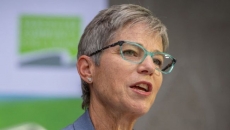
"We don't think carbon capture works as well as industry and promoters claim," said David Schissel, an analyst who wrote the report for the Institute for Energy Economics and Financial Analysis, an international non-profit agency.
"We don't think it's a good use of money to keep coal-fired power plants running."
Schissel looked at data from Sask Power's Boundary Dam project, a coal-fired power plant in southeast Saskatchewan that began capturing carbon dioxide emissions in the fall of 2014.
Proponents originally said the plant would capture up to 90 per cent of the plant's carbon emissions. That would amount to about a million tonnes of climate-changing carbon dioxide a year — the rough equivalent of emissions from 200,000 cars.
That goal has never been reached, said Schissel.
When all the plant's emissions are factored in, including flue gas that is simply vented, the average capture rate is 57 per cent, he said.
A 2022 report delivered to an international conference on carbon capture backs up the findings.
"(The project) has not sustained the design rate beyond a dedicated capacity demonstration completed in 2015," says the report from the International CCS Knowledge Centre in Regina.
The report says capture is limited by both technical issues and the demand for carbon dioxide from the energy industry, which uses the gas to extract more oil from depleting reserves.
The plant's capture rate has improved, although it's still short of the million-tonne mark.
Knowledge Centre spokesman Grady Semmens said Schissel's analysis is "generally correct."
He said the plant has managed to keep nearly six million tonnes of carbon dioxide out of the atmosphere. As well, he said almost all the CO2 from the emissions that are sent through the capture facility is separated out.
"For a variety of technical and economic reasons ... the (Boundary Dam) facility has not been run at full capacity, which has impacted the overall volume of CO2 captured over the last 10 years," Semmens wrote in an email. "This does not mean the project has not been successful.
"It has provided valuable experience and lessons that we are now actively applying to the next generation of CCS projects."
SaskPower spokesman Scott McGregor said the facility continues to improve. He said the equipment was online for almost the entire first three months of 2024 — its best performance yet.
"The knowledge we’ve gained at our (carbon capture) facility has also made SaskPower a resource for development of (such) projects in a wide range of industries outside of power generation, such as cement manufacturing, oil and gas production and chemical processing," he said in an email.
But Schissel said to live up to advocates' promises, carbon capture has to work nearly perfectly all the time.
"If you're going to try to reduce greenhouse gas emissions by capturing CO2, you've got to capture almost all the emissions and you've got to do it year in and year out for decades."
"Carbon capture hasn't done what its proponents claimed it would do."
Other carbon capture projects have yet to reach their stated goals.
Since 2015, Shell's Quest project near Edmonton has stored nine million tonnes of CO2 at a lower-than-anticipated cost. But its capture rate of 77 per cent remains below the 90 per cent originally announced.
On Wednesday, Capital Power CEO Avik Dey said the company would no longer pursue its $2.4-billion carbon capture project at its Genesee power plant.
"Fundamentally, the economics just don't work," he told analysts in a conference call. "Hopefully, the technology will improve, and we can revisit this when the economics improve.
"What it really is, is the technology improving so the costs come down. How do you actually build the kit so you have higher efficacy and capture rates while bringing down the capture costs?"
Alberta's oilsands producers have estimated the cost of the first phase of carbon capture for the industry at $16 billion.
Schissel said carbon capture can be worthwhile in some circumstances, especially at a smaller scale. He said it remains questionable if the technology can work at the level proponents suggest and asks whether it's the most cost-effective way to reduce emissions at large operations.
"We may find out in 20 years that we didn't capture as much CO2 as we needed to and we wasted a lot of money that could have been better spent."