Andrew Scheer is promising that a Conservative government would negotiate a deal to eliminate trade barriers among Canada's provinces.
The Conservative leader made the commitment Tuesday as he outlined his vision for "a stronger and freer federation" — one that is more decentralized and respectful of provincial jurisdiction in contrast to what he labelled as Prime Minister Justin Trudeau's divisive, arrogant, top-down, "my-way-or-the-highway federalism."
If the Conservatives win the Oct. 21 federal election, Scheer said he'll appoint an interprovincial-trade minister whose sole mandate would be negotiating a comprehensive, formal free-trade deal with the provinces. And he said he'd convene a first-ministers' meeting within 100 days devoted to that subject.
"I am not talking about a simple memorandum of understanding," Scheer said during a speech in Edmonton.
"The interprovincial free trade agreement will be a real free trade deal, like NAFTA, like CETA, like the TPP ... It will be a huge step forward, well beyond the current agreement."
The previous Conservative government began negotiations with the provinces on what eventually became the Canadian Free Trade Agreement, which went into force in 2017. But Scheer said there's nothing free about it since it includes 130 pages of exemptions and Trudeau "hasn't lifted a finger to fix it."
Trudeau last July appointed Dominic LeBlanc to the post of intergovernmental affairs and internal trade minister, mandated specifically to fully exercise federal jurisdiction over trade and commerce to eliminate barriers, working in collaboration with the provinces. Trudeau hosted a first ministers' meeting last December that was supposed to focus primarily on internal trade, but he was forced by hostile premiers — notably Ontario's Doug Ford, who is one of Scheer's most ardent allies — to expand the agenda to include a host of other provincial priorities.
In the end, first ministers agreed to only a few modest steps towards freer interprovincial trade: harmonizing standards in the trucking sector, including tire size and size and weight restrictions, and eliminating duplication in federal and provincial food safety regimes.
But Scheer argued that with conservative-minded, "free enterprise, pro-trade" premiers now ensconced in seven provinces, Canada has a "once-in-a-generation opportunity ... to fix this economic injustice once and for all."
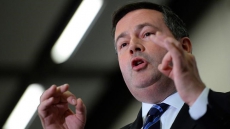
Scheer was introduced by his newest provincial ally, Alberta Premier Jason Kenney, for the fourth of five major policy speeches the federal leader is giving to set the stage for this fall's election campaign. He devoted much of his speech to lambasting Trudeau for imposing a carbon tax on provinces that refuse to put their own price on carbon emissions. Along with his policies on environmental assessments for pipeline projects and other measures, Scheer accused Trudeau of wanting to phase out the West's natural resources industry and put thousands out of work.
"Trudeau's carbon tax is a betrayal of Confederation's early promise. The discord he has sown has prompted an unprecedented number of legal actions against his government from provinces frustrated at his over-reaching" into provincial jurisdiction over natural resources, Scheer said.
He contended that Trudeau has "stoked regional alienation" and pitted region against region, threatening the country's national unity.
"It's clear that every time there's a Trudeau in the Prime Minister's Office, our union begins to crack," Scheer said. "I'm here to say unequivocally that Canada has not turned its back on the West. Justin Trudeau has."
By contrast, Scheer said he'd foster a decentralized federation, in which decision-making would be done by the smallest government closest to the people affected and in which the federal government would respect provincial jurisdiction. He promised that a Scheer government would provide stable, predictable funding for health care and other social services while allowing the provinces to decide how best to manage and deliver those programs.
Still, Scheer promised a Conservative government would provide strong leadership on matters within exclusive federal jurisdiction, where the national interest is at stake and where provinces disagree — such as on pipelines and the elimination of internal trade barriers.
He reiterated his plan to create a coast-to-coast, national energy corridor to move Quebec hydro electricity west and the West's oil and gas east. He acknowledged it would entail "a great deal of dialogue with provincial governments and Indigenous populations" and take "a lot of work." And in French, Scheer said it would not be done against the wishes of one or more provinces, which could well make it impossible to achieve.
Quebec Premier Francois Legault has categorically ruled out supporting a new pipeline through his province.
In a statement, Finance Minister Bill Morneau said Scheer's latest speech "is yet another example of the Conservatives misrepresenting what our government has already done, while over-promising on things that they know they can't deliver for Canadians."
Morneau also questioned why Scheer made no promise to meet annual with premiers, as Trudeau has done, or to meet regularly with Indigenous leaders.