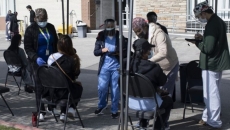
The province with the highest vaccination rate for five- to 11-year-old kids began providing the COVID-19 vaccine at schools as soon as it was approved for children, and some pediatricians say the strategy in Newfoundland and Labrador could serve as a lesson for other jurisdictions.
While nearly three-quarters of kids in the Atlantic province have had their first shot, Health Canada says the national average is less than half — a shortfall that in-school vaccination programs could help address, says pediatric infectious disease physician Karina Top.
Provinces including Saskatchewan, Quebec and Manitoba and most recently Ontario have begun offering vaccine clinics at select schools.
However, British Columbia has been a notable standout for not doing the same, even in communities with high COVID-19 cases. Alberta's health ministry said the province is not planning a school-based program for younger children after low uptake among 12- to 18-year-olds last year.
As hospitalizations fuelled by the Omicron variant climb to their highest levels in many areas, Top said infected children in the five- to 11-year age range are at risk of developing multisystem inflammatory syndrome, which could cause high fever, rash and myocarditis and pericarditis, or inflammation of the heart muscle and the lining outside the heart.
"That occurs usually a few weeks after the first COVID infection and those children are almost always hospitalized," Top said from Halifax, where she's also a researcher at the Canadian Center for Vaccinology.
"Many of them require intensive care, even though they recover. That condition is the most serious complication that we see in those young children and that can be prevented by vaccination."
While public health nurses provide Grade 6 students with routine in-school inoculations for measles, mumps and rubella each year, pediatric infectious disease physician Manish Sadarangani said it may be challenging to have enough resources to vaccinate nearly an entire elementary school.
However, targeted in-school programs may be reasonable in regions where vaccination rates are low, said Sadarangani, who is also director of the Vaccine Evaluation Center at BC Children's Hospital in Vancouver.
"It's definitely something that should be under consideration, on the table, in terms of the most efficient way to deliver COVID-19 vaccinations to this age group," he said, addingthat the collection of consent forms from parents would be an added logistical issue.
Andrew Furey, premier of Newfoundland and Labrador, said he worked with public health officials so vaccination clinics could be opened in schools as soon as Health Canada authorized a child vaccine last November.
Newfoundland and Labrador's health ministry said Thursday that 73 per cent of kids in that age range there have received a first dose, and that about 40 per cent of those shots were administered at schools.
That compares to child vaccine rates of 50 per cent in Ontario, 41.5 per cent in Alberta and 48 per cent in British Columbia, according to provincial data.
Newfoundland and Labrador removed as many barriers as possible to ramp up vaccination rates for young children, said Furey, who is also an orthopedic trauma surgeon with training in clinical epidemiology.
"We figured that it was more about accessibility than it was about acceptability," he said.
Parents can still get their kids vaccinated at mass vaccination sites but school-based programs are particularly helpful for those without access to transportation, Furey said of the clinics, held during school hours and open to parents who want to accompany their children.
Parents in some provinces, including Ontario and Manitoba, are not allowed at schools due to visitor restrictions.
Steve Buick, a spokesman for Alberta's health ministry, said the province has enough mass clinics to accommodate young children and is consulting a new vaccine hesitancy advisory committee in its efforts to encourage parents to get their kids vaccinated.
"In-school vaccination clinics for older children last year saw very limited uptake, with only about 4,000 total doses administered and 700 clinics cancelled for lack of participation, out of about 1,300 schools with children in the eligible age range," Buick said in a written statement.
In an effort to push up vaccination rates among young kids, three national non-profit organizations have joined forces by declaring Jan. 27 as National Kids and Vaccines Day, when they plan to bring together scientists, pediatricians and infectious disease specialists to offer online events for parents and children.
They include Children's Healthcare Canada, the Sandbox Project and ScienceUpFirst, which is hosting a town hall with panelists including the head of the Canadian Medical Association to answer questions from children and their caregivers.
Children's Healthcare Canada is scheduled to hold a physician-led educational session for health-care professionals providing vaccinations.
The organization's CEO Emily Gruenwoldt said getting five- to 11-year-old children vaccinated must be a priority across the country.
"This needs to be the next point of emphasis for us in this battle against COVID-19," Gruenwoldt said.
"We know that there are parents out there who still have questions so we really need to make this information about the vaccine, its safety, its efficacy, its accessibility, as available as possible for these parents."