

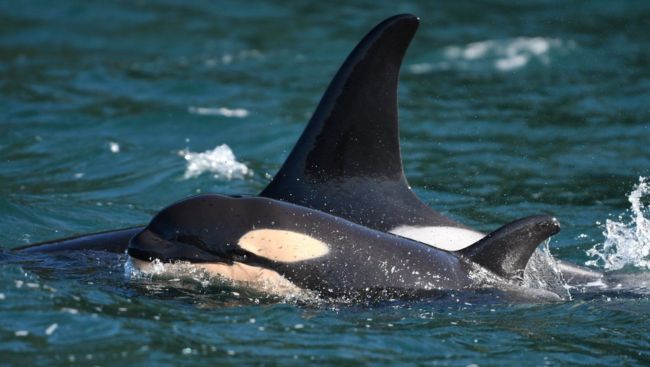
A new report from a group of more than 30 experts says a population of endangered killer whales off the coast of British Columbia and Washington state is showing no sign of recovery under the current conditions.
There is an "urgent need for more robust actions" to save the southern resident killer whales from extinction, says the report released by the David Suzuki Foundation and Raincoast Conservation Foundation on Monday.
Despite measures adopted by Canada and the United States since 2019, the report says the whales face a "high probability of extinction" if conditions don't change.
Lance Barrett-Lennard, cetacean scientist with the Raincoast foundation, says there is "no convincing reason" to believe the whales, which are genetically distinct from other orcas, will recover without stronger measures.
A statement from the B.C.-based conservation groups says the report marks the first time scientists have proposed a road map for the recovery of southern resident killer whales on both sides of the Canada-U.S. border.
The report makes a series of 26 science-based recommendations, including limiting fisheries to help the whale access their main prey, chinook salmon, along with eliminating toxic chemicals that build up in their food chains and adopting enforceable underwater noise standards.
"We specifically wanted to have a conversation that was science-focused, but we were mindful of keeping this as realistic as possible," Barrett-Lennard says.
The scientific report is the result of a workshop held in Vancouver in March that brought together 31 experts from Canada, the United States and Europe to consider what it will take to save the animals, he says.
The Fisheries Department has described the whales as a "critically endangered iconic species" of which 73 individuals remained at last census.
The federal government had determined the whales face "imminent threats" to their survival, but this spring it announced it would not issue an emergency protection order and instead adopt "incremental measures."
Barrett-Lennard says Ottawa indicated at the time that it would "strengthen" recovery measures, but he hadn't seen any further details or a timeline.
The Fisheries, Transport and Environment departments did not immediately respond to requests for comment on the report and its recommendations.
"It may take a long time, even decades, to observe the biological effects of these measures, as (the southern residents) are long-lived animals that reproduce slowly, and their recovery is expected to take time," the Fisheries Department said in its statement announcing Ottawa's decision in March.
The decision also took into account "social, economic, policy and other factors, and the broader public interest," the statement said.
Barrett-Lennard acknowledged it takes time to see signs of recovery in a population of long-lived animals with a slow reproductive rate.
The existing measures since 2019 may have helped halt the whales' further decline, but scientists are "not seeing an upturn at this point," he says.
The current population is "simply not a viable number for any species to be robust to catastrophic events like disease or an oil spill and to maintain genetic variation," he says.
The whales' main food source is chinook salmon, and the new report says limited access to prey remains the primary constraint on their recovery.
Current government initiatives from both countries are "insufficient" to address the problem, the report says.
Barrett-Lennard says the whales are particularly dependent on the largest, fattiest chinook, which spend the first year of their lives in freshwater streams.
"Those are the fish that the killer whales take preferentially and to meet their nutritional requirements," he says.
"They also tend to be the ones that fishermen love."
The report recommends ensuring the orcas have "priority access" to early-season chinook in the Fraser River through fishing closures. It also calls on government to identify seasonal and annual prey thresholds for the whales, and to close fisheries when their needs are not met.
The recommendations also include expanding slowdown zones for ships and expanding the minimum distance vessels must keep away from the whales to 1,000 metres, as well as prohibiting various ships from discharging grey water, sewage and scrubber wastewater into the whales' habitat.
Barrett-Lennard says the southern residents are an old, distinct population of orcas with great cultural significance for Indigenous Peoples in the area.
Losing the whales would be a "tragedy," he says.
"Once we identify members of the population as individuals, everything changes," he says. "We can begin to recognize individual traits and behaviours. Some of them are shy and some of them assertive."
The whales have "huge brains," he adds.
"We know that they keep track of social relationships through their whole lives. They have mental maps of the coast … They have family bonds."
Picture Courtesy: THE CANADIAN PRESS/Handout — Centre for Whale Research — Dave Ellifrit


