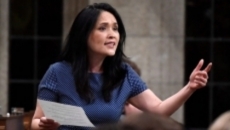
VANCOUVER - The woman appointed to work with Indigenous communities as they search for unmarked graves at former residential schools across Canada says the fight is not over for records that could answer "hard questions," including who the missing children were, how they died and where they are buried.
Without records documenting the genocide of Indigenous Peoples, special interlocutor Kimberly Murray said, "deniers will continue to deny" and future generations could be led to forget.
Survivors of the residential institutions have a "right to know," Murray told a national gathering on unmarked burials in Vancouver on Tuesday.
That right is not only individual, but collective, so the country can "draw on the past to prevent future violations," said Murray, who is a member of Kanesatake Mohawk Nation.
Prime Minister Justin Trudeau has said his government is committed to sharing all the information it can possibly find about the institutions in federal records.
Yet Murray said the search is still on for records held by Canadian authorities and churches that operated many of the institutions.
Those records have the potential to help people as they search for missing family members, she said.
"This isn't an academic exercise."
Murray said the records they are trying to obtain affect real people who are searching for information about their grandfathers, their fathers and their children.
"These records can no longer be kept in vaults with colonial institutions controlling who sees them."
A wave of searches at numerous sites of residential institutions across the country followed the Tk’emlups te Secwepemc announcement in May 2021 that more than 200 suspected unmarked graves had been identified on the grounds of the former school in Kamloops, B.C.
A war graves expert had used ground-penetrating radar to detect the graves believed to hold the remains of children who died there.
A month later, Cowessess First Nation in Saskatchewan announced as many as 751 unmarked graves had been found near the former Marieval Indian Residential School, followed by similar findings at former institutions in several provinces.
On Tuesday, the Wauzhushk Onigum Nation in northern Ontario said it had uncovered 171 "plausible burials'' in studies of cemetery grounds at a former residential school site.
The prime minister has said the revelations sparked a reckoning for Canadians about the country's history and relations with Indigenous Peoples.
Rosanne Casimir, the chief of Tk'emlups te Secwepemc, said the announcement in her community was like "ripping a Band-Aid off an old wound."
"So many people have been triggered, re-traumatized," said Casimir, who attended the national gathering on Tuesday.
Casimir said her understanding is that many records related to the Kamloops school have been turned over to the National Centre for Truth and Reconciliation, yet challenges persist with how that information is shared.
"What's missing is the survivors today and their truth, their history as part of what really happened," she says.
That's why Indigenous sovereignty or control over how residential school records are accessed and used is so important, says Casimir.
She said her community is working with a researcher and the Truth and Reconciliation Commission to compile the information needed for their investigation.
Murray told the crowd that the Truth and Reconciliation Commission has said the most serious gap in knowledge stems from the incompleteness of records.
Many documents from past decades no longer exist, including "200,000 Indian Affairs files" destroyed between 1936 and 1994, she said.
Federal policy in 1935 allowed school returns to be destroyed after five years, while reports of accidents could be destroyed after a decade, she said.
It's also become clear that "many, many, many deaths were not reported" to the former Indian Affairs Department, Murray said.
The Truth and Reconciliation Commission has found reports of children's deaths in church records that weren't recorded in government documents, she noted.
In many cases, she said school authorities appear not to have recognized their responsibility under provincial laws to report deaths to vital statistics officials.
While records are crucial, Murray added "there is nothing more powerful than the first-hand accounts from the survivors" of residential institutions.
"They are the witnesses themselves."
A 4,000-page report released by the National Truth and Reconciliation Commission in 2015 detailed harsh mistreatment at the schools, including emotional, physical and sexual abuse of children, and at least 4,100 deaths at the institutions.
Murray said the number of children who died will likely never be known in full.