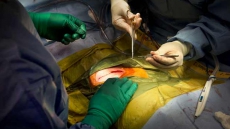
The non-profit agency that operates Canada's blood donor clinics is shutting down four permanent sites and eliminating 16 mobile clinics across the country, saying the cutbacks are needed because Canadian Blood Services is collecting too much blood.
Ian Mumford, the agency's chief supply chain officer, says advances in medicine have prompted Canada's hospitals to reduce their demand for blood products.
The agency collected 870,000 units of blood last year, but it needs only 830,000 units this year, a 4.5 per cent drop.
Four permanent clinics — in Ontario, British Columbia, Nova Scotia and Newfoundland and Labrador — will be closed as of June 1. The 16 mobile clinics will be sidelined by June 30.
"We have more than enough capacity to collect the amount of blood that we need to meet the needs of hospitals," Mumford said in an interview from Ottawa. "However, it is expensive for us to operate more clinics than we actually need to have."
Dr. Antonio Giulivi, head of hematology and transfusion medicine at The Ottawa Hospital, says less invasive surgical methods have reduced the need for blood transfusions.
As an example, he cites robotic surgery techniques used on some prostate cancer patients. The surgery once required up to three units blood, but now surgeons can get by with only one unit.
"It's a big change," Giulivi says. "This is a trend worldwide."
As well, doctors are now less likely to ask for a transfusion if a patient's hemoglobin count is low unless they are displaying obvious symptoms.
Giulivi says improved pre-surgery management has made it easier for doctors to increase red-blood-cell counts without the use of transfusions, and better drugs have been introduced to prevent blood loss during surgery.
Some hospitals have made big strides in improving their blood supply management. Giulivi oversees a network of 16 hospitals that routinely share blood products to ensure little is wasted.
Joe Kaiser, president of the Nova Scotia Union of Public and Private Employees, says Canadian Blood Services has told the union little about why it is closing its clinic in Cape Breton.
"All we're asking is, be up front with us, talk with us about it," he says.
Canadian Blood Services will continue to operate 36 permanent clinics and 909 mobile clinics across the country.
Still, Mumford says he recognizes the closure of clinics in Sydney, N.S., Corner Brook, N.L., and Prince George, B.C., will be painful. More than 40 part-time staff will lose their jobs and scores of volunteers and donors will be left with no clinic to go to.
"If you're a blood donor, you're emotional about the gift you give," he says. "You recognize the very positive impact it has on another Canadian. You're literally saving their life."
While the permanent clinic in Sarnia, Ont., will be replaced with a mobile clinic, Mumford says the other three permanent clinics are being shut down because they are too far from blood-processing centres in St. John's, N.L., Halifax and Vancouver.
As for the 16 mobile clinics, Mumford says some were serving shrinking, remote communities, while others were located too close to other mobile operations.
The closures will reduce the agency's costs by $2.9 million annually and will have no impact on patient care, Mumford says.
The decisions to eliminate clinics may seem at odds with the fact that the agency reported a critical shortage of blood last fall when supplies reached a six-year low.
However, Mumford says the temporary shortage was caused by conditions that were beyond the agency's control, pointing to low attendance at clinics during late summer.