OTTAWA — It's become the multibillion-dollar question — how big, exactly, will the federal deficit be?
Analysts have made predictions leading up to next Tuesday's spring budget on the magnitude of Ottawa's shortfall, which is already poised to reach tens of billions.
The Liberal government has acknowledged the deficit could rise above $20 billion as it fulfills election vows and introduces economy-boosting measures, such as infrastructure spending.
The government has kept mum on the final figure, but many experts anticipate Ottawa will be $30 billion in the hole in 2016-17 — at least.
Some have even recommended how large — or small — the government should allow the deficit to grow in its budgetary blueprint.
The C.D. Howe Institute is the latest to weigh in with the release today of its annual "shadow" budget, a document that urges the Liberals to show some spending restraint.
The think-tank suggests a fiscal approach that will produce deficits of $15.3 billion and $12.2 billion over the next two fiscal years — levels significantly lower than other observers.
On the other end of the spectrum, a couple of big banks and the left-leaning Canadian Centre for Policy Alternatives have recommended the government inject even more fiscal stimulus, which will create a deficit as high as $40 billion in 2016-17.
TD Bank, meanwhile, has said the federal government is on track to run $150 billion in budget deficits over the next five years.
The projections come as the government prepares its maiden budget at a time when the economy is struggling with the negative consequences of low commodity prices, particularly oil.

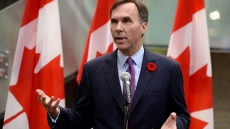
The country's economic situation darkened in the months that followed the October election, which prompted Finance Minister Bill Morneau to take the rare step last month of releasing a fiscal update only weeks before the budget.
The document revealed the treasury was projected to produce a shortfall of at least $18.4 billion in 2016-17, a projection that didn't account for roughly $10 billion in Liberal spending commitments.
The updated numbers also predicted a $15.5-billion deficit in 2017-18.
The projections also included an additional $6 billion per year for economic prudence that the government argued was necessary to account for risk.
In November, shortly after they were elected, the Liberals predicted shortfalls of $3.9 billion in 2016-17 and $2.4 billion in 2017-18.
The Liberals made a counter-intuitive promise during the election campaign when they vowed to run deficits over the next three years in order to pay for infrastructure projects to stimulate the weak economy.
They had pledged to cap annual shortfalls at $10 billion over that span, a vow they are now poised to break. The Liberals have also backed away from their campaign promise to balance the books in four years.
In releasing the grimmer numbers last month, Morneau insisted the government's starting point was "much further back" than the Liberals thought.
He has come under attack by Conservative opponents for breaking election promises and for planning to drive Canadians deeper into debt.
Morneau, however, has repeatedly maintained that spending is necessary to revive economic growth and create jobs.
The C.D. Howe Institute argues in today's report that the Liberals can support economic growth and still return to a balanced budget by 2019-20.
"Ottawa must temper the sense created by the election campaign and early post-election announcements that there are no limits to what the federal government can spend and borrow," reads the document, which includes calculations that cut the government's annual economic prudence of $6 billion in half.
Last week, the Canadian Centre for Policy Alternatives released its "alternative" budget that called for major investments in infrastructure as well as support for social programs and low-income households.
The group propose generating additional government revenues by closing tax loopholes for the wealthy, raising corporate taxes, introducing a national carbon tax and ending subsidies for the energy industry.