

Prime Minister Mark Carney and Alberta Premier Danielle Smith both said Thursday the United States needs to respect Canadian sovereignty following reports that leaders of the Alberta separatist movement met with American government officials seeking their support.
But neither agreed with British Columbia Premier David Eby's description of those meetings as "treason."
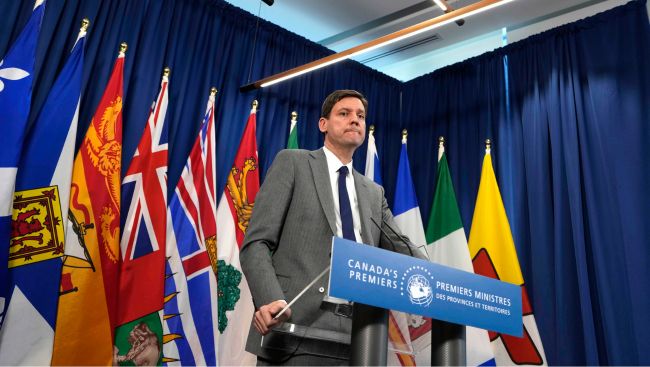
Eby, citing a report in The Financial Times, told reporters before the first ministers' meeting on Thursday that it's completely inappropriate for a group to ask a foreign power for help in breaking up Canada.
"Now, I understand the desire to hold a referendum, to talk about the issues we want to talk about in Canada," Eby said.
"But to go to a foreign country and to ask for assistance in breaking up Canada, there's an old-fashioned word for that. And that word is treason."
The Financial Times, citing sources, reported that leaders of the Alberta Prosperity Project have met three times with U.S. State Department officials in Washington since April.
Pressed to describe how they viewed those meetings, Smith and Carney did not call them treasonous.
"I would expect that the U.S. administration would respect Canadian sovereignty and that they would confine their discussion about Alberta's democratic process to Albertans and to Canadians," Smith said.
"And I will raise that with my delegate in Washington so he can raise it with members of the administration. And I'll raise it with my delegate with Ottawa so he could raise it with the U S. ambassador."
Carney initially sidestepped the question, opting instead to discuss his work with the premiers on economic policy. When pressed, he parroted Smith's words.
"I fully associate myself with Premier Smith's comments just then. I expect the U.S. administration to respect Canadian sovereignty," he said. "I'm always clear in my conversations with President Trump to that effect and then move on to what we can do together."
Carney said Trump hasn't raised the separatist movements in Quebec or Alberta in any of their discussions.
Smith said she has always been clear that she and her cabinet support "a strong and sovereign Alberta within a united Canada." But she said polls suggest about a million Albertans have "lost hope" after what she called a decade of relentless attacks by the federal government on Alberta's resource economy.
"I'm not going to demonize or marginalize a million of my fellow citizens when they've got legitimate grievances," she said.
Jeff Rath, a lawyer for the Alberta Prosperity Project who attended the meetings with U.S. officials, pushed back on the claim that his actions amounted to treason or were criminal in any way.
'We are private citizens. We don't have the authority to enter into any agreement on behalf of the province of Alberta," he said in an interview.
"We have not entered into any agreements with the United States with regard to anything. We have not solicited funds from them. We are not receiving funds from them, et cetera, et cetera."
Rath said he wouldn't disclose the names of U.S. officials he's met with but the conversations were held with the U.S. State Department.
He said plans are being finalized for another meeting next month.
The Criminal Code defines treason as using violence to overthrow a federal or provincial government, or sharing military or scientific information with an agent of a foreign state that could harm Canada.
High treason is a separate offence that involves attempting to kill, maim or imprison the monarch. It also applies to enlisting in a war against Canada or assisting an enemy who is at war with Canada.
When asked if department officials met with representatives of the Alberta Prosperity Project, a U.S. State Department official speaking on background said in an email that the department meets regularly with "civil society types."
"As is typical in routine meetings such as these, no commitments were made," the official wrote.
A White House official shared a similar response on background — that its officials meet with civil society groups and no support or commitments were promised.
Rath has said before that his organization's discussions with U.S. officials have touched on securing a $500 billion loan or fund from the U.S. to help Alberta transition into becoming a country.
He said Thursday those discussions were a hypothetical "academic exercise" and did not amount to direct solicitation of foreign funding.
"We intend to put together a dossier that would include everything, including the ultimate deal memo, that we can just hand over to the Alberta government following a successful referendum," he said.
"Whether it's through credit swaps or some sort of bond issuance through Goldman's or J.P. Morgan, we're looking at all of the options."
Eby said news of the meeting is especially alarming because Donald Trump is "not particularly respectful to Canada's sovereignty."
New Brunswick Premier Susan Holt said she believes Albertans ultimately will choose to remain in Canada, while Ontario Premier Doug Ford called the reported meeting "unacceptable" and "unethical."
"We're one country and we should all be sticking together. We shouldn't have groups going around the federal government's back or the province's back to negotiate something with the U.S.," Ford said Thursday while entering the meeting with Carney and the other premiers.
"We all know where President Trump stands. He wants Canada and that's not going to happen. We'll fight with every tool we have."
U.S. Treasury Secretary Scott Bessent said recently Alberta would be a "natural partner" for the U.S., pointing to the province's resource wealth and desire to build a new pipeline to the West Coast.
"I think we should let them come down into the U.S., and Alberta's a natural partner for the U.S.," Bessent told right-wing TV station Real America's Voice on Jan. 23.
Parti Québécois Leader Paul St-Pierre Plamondon said Thursday he would not be seeking Washington's help to hold a referendum in Quebec.
Speaking in French at a caucus in meeting south of Quebec City, St-Pierre Plamondon said his party has “no direct connection” with the Trump administration.
“Are we soliciting anything? The answer is no,” he said.
The PQ leader commended the Alberta independence movement, which he called “vibrant."
“The mere fact that citizens, or a movement, meet with American elected officials does not constitute foreign influence,” he said.
“I don’t know whether Alberta or Quebec will achieve independence first. Can we help each other? I think we can at least talk to each other.”
The Alberta independence movement is collecting signatures in an attempt to initiate a referendum on whether Alberta should separate from Canada.
Mitch Sylvestre, who is spearheading the petition for a referendum, said on Jan. 23 he doesn't think anyone in his movement wants to join the U.S.
Picture Courtesy: THE CANADIAN PRESS/Justin Tang


