Alberta Premier Danielle Smith says she's open to adjusting aspects of Alberta's industrial carbon pricing program, including the province's industrial carbon price.
The province announced last month it would maintain its freeze on the industrial carbon price at $95 per tonne through 2026, putting it out of step with the federal government's backstop price, which is set to rise to $110 per tonne next year.
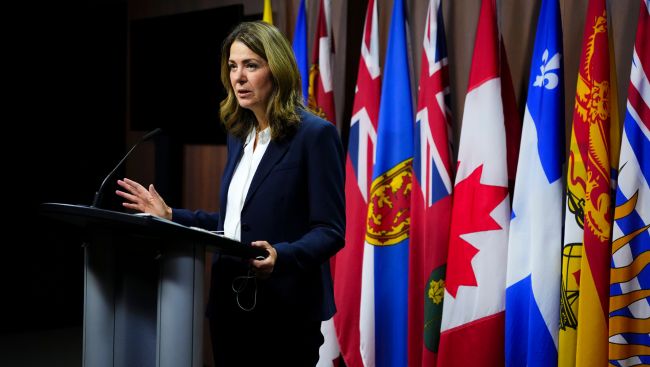
Speaking to reporters Tuesday in Ottawa a day after meeting with Prime Minister Mark Carney, Smith said Alberta believes its price strikes a balance between being viable for industry and encouraging private investment in green technology.
She said the current $95 per tonne carbon price is still "open for discussion."
"That's part of why we're having a conversation about how we adjust some of the programs," Smith said when asked whether she's received assurances Ottawa won't trigger its backstop if Alberta's system doesn't comply with federal regulations.
"We want to maintain the carbon pricing at the provincial level. We've had carbon pricing since 2007. It's worked for us."
Federal ministers have been ducking questions about whether Ottawa will impose the federal backstop on Alberta if its industrial carbon price program doesn't comply with federal regulations.
The federal backstop rate is supposed to be implemented if provinces fall behind, but it remains to be seen if Carney plans to enforce the higher price — especially since he hasn't taken action against Saskatchewan, which dropped its industrial carbon price completely earlier this year.
Carney campaigned on reinforcing industrial carbon pricing as an offset for repealing the consumer carbon price, which he did on his first day in office. A Canadian Climate Institute Study showed the industrial price — which is applied to the country's biggest emitters — would eliminate far more greenhouse gases than the consumer levy.
Alberta also proposed changes to its industrial carbon pricing program last month. They would allow companies to avoid paying provincial fees for emissions by investing in their own emissions reduction projects instead, and allow smaller companies that don't meet the program's minimum emissions threshold to opt out of the carbon pricing system for 2025. Those changes are set to come into force this fall.
While the moves were hailed as a win for industry, some observers warn the changes will discourage industry investments in clean growth.
Speaking at the House of Commons environment committee on Monday, the principal economist at the Canadian Climate Institute said the proposed changes have created "massive uncertainty" in Alberta's cap-and-trade system.
"We see prices in the future maybe at $65 per tonne, if you're lucky. And this has put an absolute chill on the market," Dave Sawyer told the committee.
"The market's illiquid, we hear from traders. When you tumble the numbers, it remains now well below the levels for major investment for decarbonization to pay."
Carbon pricing systems like Canada's industrial version work by capping maximum allowable emissions. Companies that come in under the cap generate credits they can sell to companies that exceed it.
The credits are meant to make it more cost-effective for companies to invest in emissions reduction than to simply buy credits when they exceed the cap — but that means how much the credits can sell for matters.
If the price is too low, there is no incentive to invest instead of buying credits.
Smith is negotiating with Carney to get another pipeline built from Alberta to the British Columbia coast.
She has called on the federal government to lift the tanker ban off the B.C. coast, eliminate the electric vehicle sales mandate, drop the oil and gas emissions cap and scrap the federal industrial carbon price to allow provinces to regulate themselves.
While Smith and Carney shared brief remarks during a photo-op ahead of their meeting on Monday, Smith declined to share specific details of their meeting with reporters Tuesday.
"I think (Carney) understands that there needs to be a repeal or substantial revision," Smith said when asked about the federal environmental policies she wants to see abandoned.
"Let's be frank. I mean, he did repeal the retail carbon tax. He did pause for 60 days but also delayed the implementation of the (electric vehicle mandate) when he realized that was impossible to implement it in January of 2026. That was one of the ones that was on our list as well.
"So I think he's demonstrated that if something isn't working, that he's prepared to repeal or modify."
Smith has floated the idea of a "grand bargain" which would see the proposed Pathways alliance carbon-capture project move forward alongside a proposed oil pipeline to Canada's West Coast.
Smith said she hopes the pipeline proposal — which has no private sector backer or suggested route — can be submitted for consideration by Ottawa's new Major Projects Office by next spring.
Smith told reporters on Tuesday she hopes to get a deal in place "by the Grey Cup," which is set for Nov. 16.
Picture Courtesy: THE CANADIAN PRESS/Sean Kilpatrick