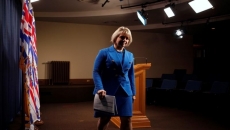
A report on last year’s deadly Snowbird crash in British Columbia has flagged concerns about the pilot’s actions in the frantic moments before the plane went down in a residential area, and says the Air Force needs to develop better procedures for such situations.
The final flight-safety investigation report released Monday said Capt. Richard MacDougall tried to turn his Tutor jet around and return to the Kamloops Airport after a bird strike caused his engine to stall shortly after takeoff on May 17.
That was despite past flight-safety reports having recommended pilots climb straight ahead to give themselves time to regain control of their aircraft or allow for a safe ejection as all previous Tutor attempts to turn around had resulted in failure.
“In these instances — all of which occurred at the same stage of flight as this occurrence — the pilots had commenced a zoom and turn towards the airport in attempt to land on a prepared surface,” the report reads.
“All occurrences resulted in insufficient energy to perform the manoeuvre and in all occurrences, the crew ejected at low level. Unfortunately, two occurrences resulted in a total of three fatalities.”
MacDougall told investigators that he was concerned about the plane crashing into a residential area, and the report notes that the “power loss could not have come at a worse time” thanks to its low altitude, speed and proximity to other aircraft and neighbourhoods.
“Reflecting on this accident, it would be easy to fall victim to hindsight bias and second-guess the actions of the pilot,” the report says.
It nonetheless calls on the Air Force to develop better guidance and training for Tutor pilots when they run into an emergency during takeoff or landing, particularly when flying near populated areas.
Investigators also mentioned concerns about MacDougall’s order to his passenger, Capt. Jennifer Casey, to eject from the aircraft. While pilots are trained to yell “Eject” three times in quick succession, the report says he instead said: “Pull the handle.”
“The format of this command is designed so that the passenger initiates ejection upon hearing the first ‘EJECT’ of the command followed by the pilot on the third ‘EJECT,’ who initiates their own ejection,” the report reads.
“This difference in wording may have contributed to the overall confusion/uncertainty of the situation which resulted in the passenger ejecting second.”
Casey, the Snowbirds public affairs officer, was killed after ejecting from the Tutor. MacDougall suffered serious but non-life threatening injuries. The military aerobatics team was participating at the time in a cross-country morale-boosting tour amid the COVID-19 pandemic.
Investigators used video shot by spectators and physical evidence to conduct their probe of the crash, which was the second involving one of the Snowbirds' 50-year-old Tutor jets in less than a year.
The investigation confirmed that the bird strike caused a compressor stall, which resulted in a loss of power to the plane. However, it also found that the strike did not cause major damage to the plane, which had no significant technical problems before takeoff.
The bird was found to be a western tanager.
One unanswered question was why Casey’s ejection seat travelled backward at one point after leaving the aircraft, and why she was unable to get clear of it. The most likely cause was that her arm or leg was extended, the report says, causing it to roll in the air.
The report found that Casey’s parachute never fully opened, and that there wasn’t enough time for the ejection system on the Tutor to operate properly because of its steep dive when MacDougall and Casey ejected.
The investigation report includes a total of five recommendations, including examining changes to the ejection system to make it more stable and the installation of flight-data recorders that can survive a crash.
The Snowbirds announced in December that they plan to fly at air shows across Canada and parts of the United States starting in June after cancelling all of last year’s season.
The federal government recently approved a project to extend the lives of the Tutors until 2030. Upgrades are expected to include new avionics and instruments as well as a glass cockpit. A separate project is underway to improve the plane’s ejection system.