British Columbia's health minister called Tuesday a "solemn day" as 4,090 health care workers missed the deadline for mandatory COVID-19 vaccination and were placed on unpaid leave before they could potentially lose their job.
Adrian Dix said 1,369 of the unvaccinated workers are in the Interior region of the province, which has a total of about 126,000 health-care workers, and that overall vaccination rates are also low in Northern health.
"Health authorities are taking steps across B.C. to deal with the challenges presented by this," Dix said.
The same day, B.C. announced a plan for all eligible residents aged 12 and up to get booster shots by next May as part of a program that is already underway for those at highest risk of breakthrough infection.
Dix joined provincial health officer Dr. Bonnie Henry in saying the loss of unvaccinated workers in the health-care system will put extra pressure on hospitals, especially as 67 seriously ill patients, most of them with COVID-19, have already been flown out of the Northern region to other areas of the province for care.
"It is an immense thing. I can't tell you the work being done by our ambulance teams, by our nurses, all those involved in patient travel," he said.
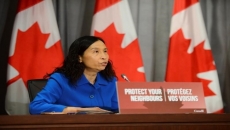
Henry said there are concerns that breakthrough infections could add more strain on health-care workers who have abided by the mandate to get vaccinated and it's essential for anyone working in the system to be immunized to protect their colleagues and patients as well as communities.
"It is so disruptive and detrimental to care when we have outbreaks in hospitals as we have a couple right now. And that is the reason why we have this vaccine mandate in place," she said.
Health-care workers who remained unvaccinated on Tuesday were given until Nov. 15 to get their first dose unless they have a medical exemption, though Henry has said those would be rare.
The deadline for long-term care workers to be vaccinated was Oct. 12, and Dix said that while more employees have been hired in that sector, recruitment will be more challenging for jobs requiring extensive training.
The B.C. Nurses Union said it could not provide an estimate of how many of its members are vaccinated. Doctors of BC, the association that represents 15,000 physicians, said about 97 per cent of its workforce has been vaccinated.
Troy Clifford, president of the Ambulance Paramedics of BC, CUPE Local 873, said up to 200 of the 4,500 paramedics and dispatchers represented by the union had either not reported their vaccine status or chosen not be vaccinated until about two weeks ago.
He said the union has tried to educate hesitant members about the science-based reasons for vaccination and that he's struggling to understand the rationale of those who could lose their careers.
"We do appreciate the choice that people are making. But with choice comes a consequence and right now the consequence is you won't be able to work," Clifford said. "But the public has an expectation, I believe, of the front-line workers, and I think we have a duty to protect our patients and each other."
The province's booster-shot plan began last month with the most vulnerable seniors over 70, Indigenous Peoples in rural and remote communities as well as front-line health-care workers.
Henry said those groups and people who are most immunocompromised were vaccinated first and are getting to the point of waning immunity. They are expected to be prioritized until December before the general population will be eligible for booster shots starting in January.
"I believe that this extra protection for our seniors and elders who have been so affected by the pandemic will make an important difference in helping us get through this respiratory season, making sure that we're not adding additional burden to our hospitals as influenza is starting to appear as well."
Appointment bookings will be offered based on the time since the second dose, typically six to eight months, Henry said.
She added that British Columbians had longer intervals between their first and second doses, leading to longer and stronger protection compared with programs in other jurisdictions, including the United States and Israel.
"They went with a very short interval, a three-to-four-week interval between dose one and dose two. And our data, and data around the world have shown that means you get that earlier waning of immunity over time. We've also taken a different approach earlier than many other provinces in Canada," she said.
"Very few people in long-term care in B.C. had their first two doses at a shortened interval, unlike other provinces, particularly Alberta and Ontario."
Over 84 per cent of British Columbians aged 12 and up have received both doses of a COVID-19 vaccine.
The province reported 457 new cases of COVID-19 on Tuesday and two more deaths.