One of two finalists in the competition to build the Royal Canadian Navy’s next fleet of submarines is pitching multiple industrial partnerships and economic benefits in the hopes of sealing the deal.
Hanwha Oceans is floating various industrial-technological benefit collaborations that could involve investments in Canadian lithium-ion battery production, liquefied natural gas, aerospace, steel, critical minerals mining and sustainable energy.
Although the firm is keeping its cards to its chest on the specifics — part of an unsolicited proposal it made to the Canadian government in July — the company promises more details in the coming weeks and insists the investments would be significant.
“We've talked about everything from energy co-operation to battery co-operation to … other areas where Hanwha is particularly strong, like infantry-fighting vehicles and howitzers," said Hanwha Global Defense CEO Michael Coulter in an interview with The Canadian Press.
“We know that there's a requirement in the Canadian military for howitzers. The offering has evolved beyond submarines because what the Canadian government is looking for is beyond submarines. It's true industrial capacity in Canada.”
The company points to what it calls a “friend-shoring” initiative which saw it open an armoured vehicle plant in Geelong, Australia a year ago. The company says roughly 1,000 employees now work there building fighting vehicles and self-propelled howitzers.
It’s angling for something similar in Canada. Hanwha has offered to construct two submarine “sustainment” facilities on both coasts and also envisions a manufacturing facility in Canada to build tanks, rockets, howitzers and resupply vehicles.
“On a submarine program, it is a decades-long endeavour to maintain and support that," Coulter said.
He said Hanwha wants "to have the entire life cycle" of the subs, "support, maintenance, all of that," operated "in Canada by Canadians" for "decades to come."
“That is the framework of how we're thinking as a company right now," he said.
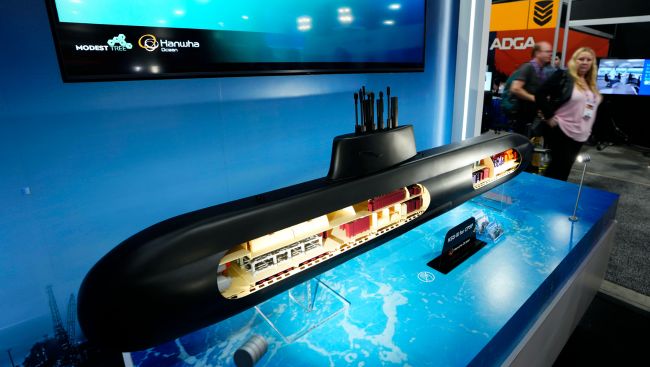
Hanwha hosted a delegation from Canada earlier this week that included Stefanie Beck, deputy minister of defence. The Canadians toured the company's Geoje shipyard in South Korea and took a close-up look at the submarine model Hanwha vows is Canada’s best option.
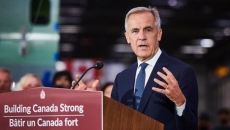
Prime Minister Mark Carney is expected to visit the yard next month. On Aug. 26, he visited a submarine facility in Kiel, Germany owned by a rival bidder.
Every time Hanwha has a meeting with Canadian officials, it appears to update its game plan for selling Canada on the KSS-III, its lithium-ion powered sub model. The South Korean navy currently has three of them in the water.
Hanwha, which touts itself as South Korea's seventh-largest business group, is known for its aggressive marketing and sales and is pursuing a global expansion strategy. It's a regular fixture at the annual CANSEC defence expo in Ottawa, where it has advertised the subs for several years now.
South Korea is hungry to grow its domestic defence industry and has pushed hard to expand exports. The country has been on a war footing for decades because of its menacing neighbour to the north, and is seeking to move itself away from overreliance on the U.S. for defence matériel.
The country, which was the eighth-largest arms exporter in the world in 2023, wants to become the fourth-largest by 2027, according to an internal National Defence review obtained through access to information law.
The top four arms exporters currently are the U.S., France, Russia and China.
"Successive (Korean) governments have relied on a mix of financial inducements, flexible joint-production arrangements in host countries, 'package deals' that include non-military products and co-ordinated diplomatic support to boost sales," the National Defence document said.
The other contender for the sub contract is the German firm ThyssenKrupp Marine Systems, or TKMS.
It's pitching Canada on its track record as one of the world's longest-established sub builders, having supplied some 70 per cent of NATO’s conventional sub fleet.
TKMS is also attempting to sell Canada on interoperability with allies — the same argument used by supporters of Canada's purchase of American F-35 fighter jets.
Germany and Norway have together ordered a dozen of TKMS's 212 CD (Common Design) submarines, the model the firm is trying to sell to Canada.
TKMS also says it can beat Canada’s tight 2035 deadline for its first sub delivery.
Hanwha, meanwhile, is also focusing its sales pitch on Ottawa’s need for speed.
The Canadian navy's four Victoria Class subs will be out of commission within a decade. Carney has pointed out that only one of them is currently in working order.
Hanwha says that if Canada signs a contract next year, it can leverage its massive shipyard capacity — totalling five kilometres square — to build four KSS-III submarines by 2035, with the first to be delivered 2032.
It says it could send Canada a new sub every year after the initial four are delivered, giving it a full fleet of 12 by 2043.
The company claims this could allow Canada to avoid $1 billion on repairs by retiring the Victoria subs early. Hanwha says the 12 subs would cost in the ballpark of $20-24 billion, which does not include the infrastructure to service them.
The Carney government is moving fast on the sub file. It only announced the procurement a year ago and has already ruled out most of the competition. Procurement projects this massive tend to move very slowly through the Canadian bureaucracy.
Navy Commander Admiral Angus Topshee even suggested in a recent television interview that it’s possible for Ottawa to arrive at a decision by the end of the year.
“It appears that the Canadian government is very intent on moving quickly and moving differently,” Coulter said. “We're a little bit in uncharted waters, so our intent is just to stay very close to the customer, understand as best we can what they are looking for and to be committed to that.”
Picture Courtesy: THE CANADIAN PRESS/Justin Tang