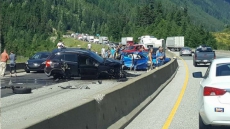
OTTAWA — Before proceeding with its pot-legalization agenda next spring, the Liberal government is promising to tackle the issue of drug-impaired driving, which bureaucrats say could spike considerably if marijuana becomes legal.
Justice Minister Jody Wilson-Raybould was warned by officials in January of the risks, a classified briefing document obtained by The Canadian Press shows.
"The legalization of marijuana could lead to a significant increase in drug-impaired driving cases," the memorandum reads.
Bureaucrats say there is limited data as only two jurisdictions in the United States have legalized marijuana: Colorado and Washington.
"For example, in Colorado, in the year following marijuana legalization, there was a 32 per cent increase in marijuana-related traffic deaths," the memo reads.
Liberal MP Bill Blair, a former Toronto police chief and now parliamentary secretary to Wilson-Raybould, says the issue is already a serious problem in Canada and that legalization could lead to more cases.
"That's why it's so important to do the work upfront to educate Canadians and to provide law enforcement and the justice system with the tools they need to control that illegal behaviour on our roadways," said the Toronto MP, who is the Liberals' point man on marijuana legalization.
"We recognize its urgency."
The Liberal government has promised to table a bill on legislating cannabis in the spring of 2017 — a timetable deemed far too ambitious by the Opposition, which would rather see the government slow down the process rather than expose Canadians to risks.

Conservative public safety critic Alain Rayes said the danger is real and accused the Liberals of venturing "too far, too fast."
New Democrat Alexandre Boulerice said if the road safety issue is not addressed specifically, it would be a "major obstacle" to his party's support of any future bill.
Some groups, like Mothers Against Drunk Driving (MADD), have called for Criminal Code amendments.
Marie-Claude Morin of MADD said the organization wants cannabis to be subject to the same laws that currently apply to driving under the influence of alcohol, but to have the two impaired-driving offences appear distinct in the code.
That could result in the addition to the Criminal Code of a legal limit of active tetrahydrocannabinol in the body.
In Washington and Colorado, the legal limit is five nanograms of THC per millilitre of blood. In Nevada and Ohio, the legal limit is lower — two nanograms per millilitre. Other states have opted for zero tolerance.
"There will be the discussion about what's safe," Blair said. "And that discussion will range from a total prohibition — so no use of drugs in driving — to determining a safe level."
Blair said any such changes to the Criminal Code could come before tabling legislation in 2017.
In 2013, 97 per cent of accidents in Canada relating to impaired driving were alcohol related. The other three per cent were linked to drug consumption.
The briefing document to Wilson-Raybould suggests the drug-impaired numbers are under-reported because it's more difficult for police to detect.
Blair, a police office for 40 years, concurred with that assessment.
"It's very difficult to identify and to prove a level of impairment by marijuana," Blair said. "We have good tools for alcohol. We do not currently have good tools for cannabis."
In Quebec, provincial police say they are satisfied with the current system — a patrol officer arrests someone who is believed to be intoxicated and another officer, trained in drug recognition, does a more extensive test.
Daniel Thibaudeau, a Quebec police spokesman, said between 2011 and 2014, 781 arrests were made for drug-impaired driving involving all types of substances.
MADD believes Canada should follow an example set in Australia and certain European Union countries, where police use roadside oral fluid drug-screening tests to detect the presence of THC.