Wednesday, December 31, 2025
ADVT 
National

Spy service to get stronger anti-terror powers under federal bill

Darpan News Desk The Canadian Press, 30 Jan, 2015 10:49 AM

    OTTAWA — Newly tabled anti-terrorism legislation would give Canada's spy agency more power to thwart a suspected extremist's travel plans, disrupt bank transactions and covertly interfere with radical websites.

    The plan to boost the Canadian Security Intelligence Service's ability to counter terrorist threats flows from a review of fatal attacks on two Canadian soldiers last October — incidents the government believes were fuelled by Islamic extremism.

    As expected, the bill would also make it easier for the RCMP to obtain a peace bond to restrict the movements of a suspect and it extends the period for preventative arrest and detention.

    In addition, the legislation would expand the no-fly regime to cover those travelling by air to take part in terrorist activities, whereas currently there must be an immediate risk to the plane.

    The bill proposes giving the RCMP power to seek a judge's order to remove terrorist propaganda from the Internet.

    It would also create a new criminal offence of encouraging someone to carry out a terrorism attack.

    Prime Minister Stephen Harper told a gathering in Richmond Hill, Ont., that his Conservative government is prepared to both condemn and confront terrorism.

    "Jihadist terrorism is not a future possibility, it is a present reality," Harper said.

    "It seeks to harm us here in Canada, in our cities and in our neighbourhoods through horrific acts."

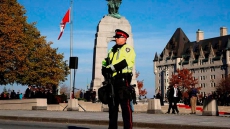
    On Oct. 22, Michael Zehaf Bibeau shot Cpl. Nathan Cirillo, an honour guard at the National War Memorial, before rushing into Parliament's Centre Block. Zehaf Bibeau was quickly gunned down.

    Two days earlier, Martin Couture-Rouleau had fatally rammed Warrant Officer Patrice Vincent with a car in St-Jean-sur-Richelieu, Que. After a chase, police shot and killed the knife-wielding assailant.

    It soon emerged the RCMP had been monitoring the man — who harboured jihadist sympathies — for months.

    The Mounties even prevented him from travelling overseas, presumably to join militant fighters. But they did not have enough evidence to arrest him or further limit his movements, saying extreme beliefs were not a crime.

    Existing law requires a fear that someone "will commit" a terrorism offence before police can obtain a peace bond — a tool that can mean jail unless a suspect abides by strict conditions, for instance that they surrender their passport and regularly report to police.

    The new, lower threshold would be reasonable grounds to fear a person "may commit" a terrorism offence.

    Current anti-terrorism law allows police to arrest someone without a warrant and hold them for up to three days before a hearing. Under the bill, maximum period would be extended to seven days.

    Other proposed measures would:

    — Allow for more information-sharing when the material — such as passport or immigration information — is relevant to an agency's national security mandate;

    — Give the government more power to object to disclosure of classified information in immigration proceedings.

    MORE National ARTICLES

    G20 disciplinary hearing for Toronto cop to resume on Dec. 1 with new judge

    G20 disciplinary hearing for Toronto cop to resume on Dec. 1 with new judge
    TORONTO — A disciplinary hearing for the most senior police officer charged in relation with mass arrests made during Toronto's G20 summit, which was put on hold last week after the presiding judge fell ill, will resume on Dec. 1.

    G20 disciplinary hearing for Toronto cop to resume on Dec. 1 with new judge

    Flexibility, partnerships key to modern policing, says federal panel

    Flexibility, partnerships key to modern policing, says federal panel
    OTTAWA — A federally commissioned study says police must be more flexible and seek out partnerships to succeed in the 21st century.

    Flexibility, partnerships key to modern policing, says federal panel

    Sex offenders convicted abroad may be missing from national registry: auditor

    Sex offenders convicted abroad may be missing from national registry: auditor
    OTTAWA — The national sex offender registry may not include some Canadians convicted of crimes abroad because the RCMP doesn't have access to Foreign Affairs information on convicts released from prisons in other countries.

    Sex offenders convicted abroad may be missing from national registry: auditor

    Auditor questions whether soldiers get all of their entitled moving benefits

    Auditor questions whether soldiers get all of their entitled moving benefits
    OTTAWA — The RCMP gets a passing grade from the auditor general for the way it handles its multimillion-dollar relocation program, but National Defence is once again facing tough questions about how it moves members around the country.

    Auditor questions whether soldiers get all of their entitled moving benefits

    Auditor cites problems in Syria projects, military water purification

    Auditor cites problems in Syria projects, military water purification
    OTTAWA — Funding delays of more than a year plagued two major Canada humanitarian assistance projects in Syria, while the military's water purification system didn't measure up during last year's typhoon in the Philippines.

    Auditor cites problems in Syria projects, military water purification

    Government not doing enough to keep tabs on northern food-subsidy program: audit

    Government not doing enough to keep tabs on northern food-subsidy program: audit
    OTTAWA — The auditor general says the federal government can't tell if northerners are reaping the full benefit of a program aimed at helping to offset the high cost of food in the North.

    Government not doing enough to keep tabs on northern food-subsidy program: audit