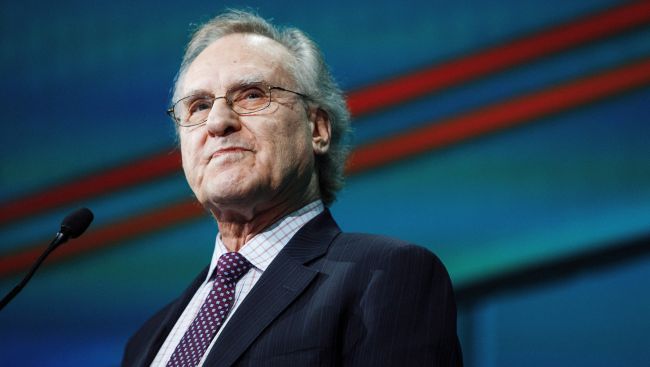
Human rights. Equality for women. The plight of African families decimated by HIV-AIDS. Stephen Lewis spent a lifetime fighting for causes close to his heart — and his weapons of choice were words.
Lewis died on Tuesday, at the age of 88, after an eight-year battle with stomach cancer.
"Stephen spent the last eight years of his life battling cancer with the same indomitable energy he brought to his lifelong work: the unending struggle for justice and dignity for every human life," his family said in a statement released shortly after his death.
"The world has lost a voice of unmatched eloquence and integrity."
Lewis had few equals in this country as a writer and orator. He spent decades passionately championing the economically downtrodden and disenfranchised, warning the world of the threat of climate change and railing against physical and sexual violence visited upon women and children everywhere.
Always eloquent and never one to mince words, Lewis didn't suffer fools gladly. But he had an inherent ability to work with others to get things done — whether as leader of the Ontario New Democrats in the 1970s, during diplomatic postings to the United Nations or as head of his foundation that provides support to African communities shattered by HIV-AIDS.
Lewis was born in Ottawa on Nov. 11, 1937 to Sophie (née Carson) and David Lewis, who was national secretary of the Co-operative Commonwealth Federation (CCF), forerunner of the NDP, and later that party's federal leader. Lewis's grandfather Moishe Lewis was an activist in the Jewish Labour Committee in Montreal.
Growing up the eldest of four children in a family steeped in politics and social activism, Lewis learned early on to hone his oratory. In 1956, he entered the University of Toronto, where he joined the Hart House debating team. A year later, that team squared off against then-U. S. senator John F. Kennedy on the question: "Has the United States failed in its responsibilities as a world leader?" The future president narrowly beat the Hart House team 204-194.
Lewis switched to the University of British Columbia in third year, then returned to U of T for his final year, but didn't write his final examinations. He went to law school twice in the early 1960s but dropped out both times. After university, he travelled to Africa, where he taught English and fell in love with the continent.
In 1963, he married journalist and social activist Michele Landsberg. The Toronto couple had three children, Ilana Landsberg-Lewis, Jenny Leah Lewis and federal NDP Leader Avi Lewis, who is married to writer Naomi Klein.
Avi Lewis was elected as the leader of the federal NDP on Sunday in a first ballot victory.
During his acceptance speech in Winnipeg Sunday after winning the NDP's leadership, Lewis acknowledged his father was "not doing too well" but was hanging on to see the next chapter of "the movement."
"Ever the political fanatic, dad has demanded daily updates about our organizing, delivered to his hospital bed — a veritable IV drip of campaign data," he said. "At age 88 he is more passionate about the promise of democratic socialism than he has ever been in his life."
The Lewis family said Avi is travelling to Toronto to be with his family.
Lewis began working for the federal New Democratic Party and in 1963, at the age of 26, was elected to the Ontario legislature. In 1970 he became leader of the provincial NDP, which in 1975 became the official Opposition. In 1978, a year after the party suffered an electoral setback, Lewis resigned as leader and became a media commentator, lecturer and labour arbitrator.
In 1984, then-prime minister Brian Mulroney appointed Lewis as Canada's ambassador to the United Nations, a post he held for four years. He was then named special adviser to the UN's secretary-general on African affairs, a post he held until 1991. From 1995 to 1999, Lewis was deputy director of UNICEF and from 2001 to 2006 served as the United Nations special envoy for HIV-AIDS in Africa.
Picture Courtesy: THE CANADIAN PRESS/Codie McLachlan