Saturday, December 27, 2025
ADVT 
National

Stricter rules for Americans heading to Alaska

Darpan News Desk The Canadian Press, 30 Jul, 2020 06:29 PM
  • Stricter rules for Americans heading to Alaska

The federal government is tightening the rules for non-essential American travellers passing through Canada en route to Alaska, in order to reduce the time spent in the country during the COVID-19 pandemic.

Canada Border Services Agency says U.S. travellers heading to Alaska will be required to use one of five designated border crossings: four in B.C. and one in Alberta.

They must also take the most direct routes possible, avoiding all national parks and tourist activities, and will be issued a tag to hang from their vehicle's rear-view mirror for the duration of their trip to ensure compliance with the rules.

Before entering the U.S., Alaska-bound travellers must report to the nearest Canadian border checkpoint to confirm their exit from Canada.

These measures will also apply to Americans travelling from Alaska to the U.S. through Canada, but U.S.-bound travellers will be permitted to use any border crossing of their choosing.

Any Americans who show symptoms of COVID-19 will not be allowed to enter Canada, and anyone found to have presented false information to a Canadian border officer could be denied entry or banned from returning to Canada.

Restrictions on non-essential travel across the Canada-U.S. border have been in place since March 21 due to COVID-19, but Americans are permitted to travel through Canada by car if they are heading to Alaska.

In June, posts on social media claimed some Americans had been visiting popular tourist destinations in Canada, such as Banff National Park, after telling border agents they were driving to Alaska.

The RCMP issued tickets to some individuals for violating the Public Health Act during the COVID-19 pandemic.

These new border measures are aimed at trying to limit the time Americans spend in Canada while in transit to the northernmost U.S. state, which can only be accessed by going through Canada if travelling by land.

Following admission into Canada, travellers are given a handout telling them they must avoid contact with others while in transit, remain in their vehicle as much as possible and should pay for gas at the pump and use drive-through options for food.

They are told not to make any unnecessary stops and to wear a mask or face covering.

CBSA is encouraging these travellers not to make any detours and only use services that are available along their direct route.

MORE National ARTICLES

Metro Vancouver home sales down 39.4 per cent in April to near 40-year low

Metro Vancouver home sales down 39.4 per cent in April to near 40-year low
The Real Estate Board of Greater Vancouver says home sales dropped by 39.4 per cent in April from a year earlier to hit an almost four-decade low.

Metro Vancouver home sales down 39.4 per cent in April to near 40-year low

More remains found as helicopter search turns to recovery

More remains found as helicopter search turns to recovery
After scouring a littered seascape with its NATO allies, a Canadian Forces warship formally ended its search for survivors Friday after its maritime helicopter crashed off the coast of Greece.

More remains found as helicopter search turns to recovery

Real estate firm Colliers International says about one in five surveyed commercial tenants requested April rent relief as the COVID-19 shutdown hits business activity

Real estate firm Colliers International says about one in five surveyed commercial tenants requested April rent relief as the COVID-19 shutdown hits business activity
Real estate firm Colliers International says about one in five commercial tenants surveyed requested April rent relief as the COVID-19 shutdown hit business activity. The company says that 21 per cent of the 7,100 retail, industrial, and office tenants in its managed portfolio across Canada requested relief, and close to half of that share indicated they could not afford to make their rent payment.

Real estate firm Colliers International says about one in five surveyed commercial tenants requested April rent relief as the COVID-19 shutdown hits business activity

Teachers in B.C. agree to new contract with provincial government

Teachers in B.C. agree to new contract with provincial government
B.C. teachers have voted to approve a new, three-year collective agreement with the provincial government. The deal with the B.C. Public School Employers' Association includes general wage increases of two per cent every year along with a mediated process on how to better support negotiations in the future.

Teachers in B.C. agree to new contract with provincial government

B.C.'s $1,000 worker benefit online today

B.C.'s $1,000 worker benefit online today
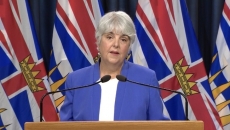
Finance Minister Carole James says thousands of people applied for British Columbia's $1,000 tax-free emergency benefit in the first minutes of the program going online today.

B.C.'s $1,000 worker benefit online today

Vancouver police are reporting a spike for April in anti-Asian hate-motivated incidents

Vancouver police are reporting a spike for April in anti-Asian hate-motivated incidents
Vancouver police are reporting an increase in anti-Asian, hate-motivated incidents in recent weeks. The department makes the announcement as it seeks public help to identify a man seen scrawling graffiti on several large windows at the Chinese Cultural Centre on April 2. 

Vancouver police are reporting a spike for April in anti-Asian hate-motivated incidents