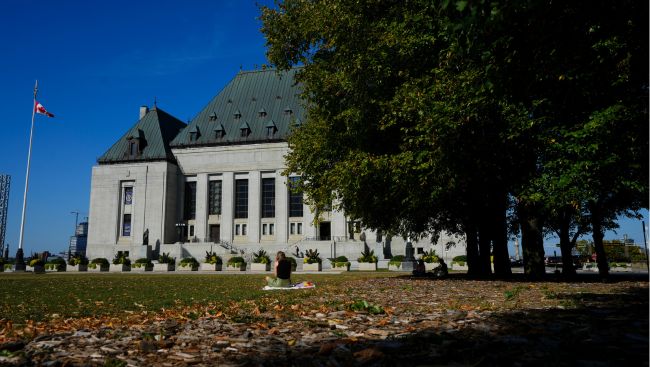
The Supreme Court of Canada has affirmed the acquittal of a man who was arrested at the scene of a drug overdose, saying he had immunity under a law intended to reduce the number of substance use deaths.
The top court's 6-3 judgment Friday said Paul Eric Wilson's arrest in Saskatchewan five years ago seriously violated his Charter rights due to the shielding effect of the Good Samaritan Drug Overdose Act.
In 2017, Parliament passed the Good Samaritan law — an amendment to the broader Controlled Drugs and Substances Act — to help save lives from overdoses.
Under the provision, no one who seeks emergency medical or police assistance can be charged or convicted of simple drug possession if the evidence was discovered because that person sought assistance or stayed at the scene of the emergency.
Wilson was with three companions in Vanscoy, Sask., in September 2020 when one of them slipped into unconsciousness after using fentanyl.
A member of the group called 911 and an RCMP officer arrived.
Wilson was arrested for drug possession and, after a search, was arrested a second time.
Wilson was not charged with any drug offence. He was, however, eventually convicted on several firearm and identity document charges.
In 2023, Saskatchewan's Court of Appeal overturned Wilson's convictions and entered acquittals.
It concluded that Wilson could not be charged with simple possession of a controlled substance due to the Good Samaritan provision, and therefore his first arrest was unlawful.
In its ruling Friday, the Supreme Court upheld the Court of Appeal decision.
The immunity from charge and conviction for simple possession explicitly mentioned in the Good Samaritan provision includes, by necessary implication, immunity from arrest for that offence, Justice Andromache Karakatsanis wrote on behalf of the majority of the top court.
"This interpretation best serves the clear purpose of the provision: to save lives," she said.
An interpretation that allows arrests for possession, and intrusive searches incident to those arrests, would create a strong disincentive to seek emergency assistance in life-threatening overdose situations, Karakatsanis added. "Parliament did not intend this result."
Since the Good Samaritan provision immunizes eligible individuals from arrest for simple possession, the initial arrest of Wilson was unlawful and breached his Charter right to be free from arbitrary detention, Karakatsanis said.
In turn, this means the search incident to that arrest was not authorized by law and was a breach of his Charter guarantee against unreasonable search or seizure, she added.
Wilson had immunity under the Good Samaritan provision when he was arrested for possession, Karakatsanis wrote.
"Arresting him despite his immunity was a serious breach of his Charter rights that warrants the exclusion of evidence gathered consequent to the arrest," she said. "The Court of Appeal was right in the circumstances to enter acquittals on all charges."
The Vancouver-based Pivot Legal Society, which intervened in the Supreme Court case, applauded the decision.
"At a time when governments at every level are continuing to back the deadly war on people who use drugs, we needed a ruling like this," said Caitlin Shane, a staff lawyer for the group.
The Canadian Drug Policy Coalition, the Harm Reduction Nurses Association and l'Association des intervenants en dépendance du Québec intervened in the case as a coalition.
"We are relieved and happy," said Corey Ranger, president of the nurses' association. "As health-care providers, we see the consequences when people delay calling 911 — brain injuries, trauma and deaths that could have been prevented."
Ranger said the court has recognized that "harm reduction saves lives, and that protecting public health must be prioritized over punishment."
Picture Courtesy: THE CANADIAN PRESS/Sean Kilpatrick