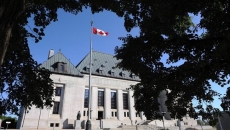
The Supreme Court of Canada reserved judgment on the national carbon tax Wednesday.
After two days of hearings and presentations from more than two dozen interested parties, the court adjourned without yet deciding whether the carbon price is constitutional.
A decision could take several more months.
The hearings brought together three separate appeals related to the federal government's Greenhouse Gas Pollution Pricing Act, which sets minimum standards for carbon pricing and imposes a federal system on provinces that don't have an equivalent version of their own.
Appeals courts in Saskatchewan and Ontario ruled in 2019 that the federal carbon tax legislation was constitutional, but in February of this year, the Alberta Court of Appeal said it was not.
Those provinces argued the law leaks into provincial jurisdiction during the first day of hearings Tuesday, while the federal government and British Columbia both defended the law as being in the national interest.
On Wednesday, the court heard from Quebec, New Brunswick and Manitoba, which all argued the law should be struck down. Quebec was one of the first provinces to have a carbon pricing scheme, with its cap-and-trade program, that started in 2013.
Nevertheless, lawyer Jean-Vincent Lacroix told the Supreme Court Quebec strongly feels like Ottawa should not get to decide if provinces have acceptable systems.
Manitoba and New Brunswick both had the federal tax imposed on them in 2019, but that changed for New Brunswick earlier this year after it implemented a provincial program. Premier Blaine Higgs said last fall he would adjust New Brunswick's policy after the federal election, where a majority of New Brunswick voters cast ballots for parties that backed a carbon tax.
Both provinces argued in court that they should be in control of greenhouse gas policies. Manitoba lawyer Michael Conner said the reason provinces have their own jurisdiction is that there is not a one-size fits all policy that would work, and that carbon pricing will have a different impact depending on where it is applied.
A lengthy list of environmental experts and advocates pleaded with the court to recognize the seriousness of climate change and the necessity of having a national response to it.
Stewart Elgie, speaking in court on behalf of the Ecofiscal Commission, said the court has many times before ruled in Ottawa's favour when it came to national policies to manage pollution that crosses provincial borders, including water pollution and clean air.
New Brunswick lawyer Rachelle Standing likened it to how provinces had their own ways of trying to address the COVID-19 pandemic, such as New Brunswick's decision to close its borders to outsiders.
That prompted Justice Rosalie Abella to ask her how she thought New Brunswick could possibly close its borders to greenhouse gas emissions.
Most justices expressed confidence that the science on climate change as a crisis is clear but some expressed concerns the federal law might be too broad.
The carbon tax is a central pillar of the Liberal's climate change agenda, accounting for as much as 40 per cent of the emissions cuts it has planned for in order to reach its goals under the Paris climate change agreement.
Ontario and Saskatchewan's appeals were to be heard in March but were delayed by COVID-19, which allowed enough time for the Alberta case to be added to the mix.
This is the first in-person hearing the court has had since COVID-19 shut things down in March. The justices sat in two rows, further apart than usual, with clear shields erected between them.
On Wednesday, several of the interveners presented their arguments by video link.