OTTAWA - The B.C. government will ask Canada's high court Thursday to give it authority over what can flow through the expanded Trans Mountain pipeline from Alberta.
The case is a make-it-or-break-it affair for the multibillion-dollar project: if B.C. is allowed to prevent heavy oil from flowing through the pipeline, it would crush the expansion's entire reason for being. It is also a significant case for the federal government, which bought the pipeline in 2018 when B.C.'s court challenge convinced Kinder Morgan Canada the political opposition created too much risk that the project would never be completed.
The federal government will argue that letting B.C. regulate what can flow through the pipeline would give the province a veto over interprovincial projects it doesn't like, counter to the constitutional authority given to Ottawa over any transportation project that crosses provincial boundaries.
B.C.'s NDP government, which was elected in 2017 in part on a promise to oppose the expansion, acknowledges the Constitution but says B.C. has authority to protect its environment. There, the province argues it should be able to restrict heavy oil flows in the pipeline because it is B.C. that will bear the environmental brunt of any spill if the pipeline ruptures.
B.C. specifically wants to be able to require companies to get permits before shipping heavy oil through pipelines in B.C. A permit could be withheld if a company can't show efforts to prevent a spill and policies to clean up and compensate if one does occur.
In a factum filed with the Supreme Court of Canada, the B.C. attorney general says "the heart of the Constitutional questions before this court" is whether B.C.'s authority to protect its own environment can include interfering in a federal project.
Last May, the B.C. Court of Appeal said it cannot.
B.C. is appealing that decision to the Supreme Court of Canada and the hearing is set for Thursday morning in Ottawa. Four provinces, the cities of Burnaby and Vancouver, several Indigenous communities, the environmental law charity Ecojustice, and more than half a dozen oil companies and advocacy groups have been granted intervener status in the case.
In their written arguments filed with the Supreme Court, Ottawa's lawyers say the B.C. Court of Appeal was correct when it said B.C.'s proposed permitting process is not a general environment law, but rather one specifically intended to restrict or even bar heavy oil from flowing through the Trans Mountain expansion.
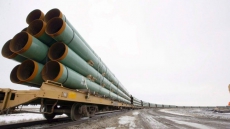
The Trans Mountain expansion involves building a new pipeline roughly parallel to the existing Trans Mountain Pipeline that runs between Edmonton and a marine terminal in Burnaby, B.C. The existing pipeline would continue to carry mostly refined products like gasoline, and light crude oil. The expansion, with almost twice the capacity, would ship diluted bitumen, a heavy crude oil produced in Alberta's oilsands, to be loaded onto tankers for export.
If B.C. can prevent heavy oil from flowing through the new pipeline, there is no reason to build it.
The expansion has been in the works for almost a decade and has become a political lightning rod for Canadians advocating for the phasing-out of fossil-fuel production in Canada to curb climate change and those fighting to support an industry that is a critical part of Canada's economy. First proposed in 2012 during the former Conservative government's tenure, the pipeline was approved by the federal Liberals in 2016 a year after they came to power.
Almost two years later, the Federal Court of Appeal overturned that approval, saying Ottawa had failed in its duty to consult affected Indigenous communities and hadn't fully considered the impact on marine life from having more oil tankers in B.C. waters, carrying heavy crude from the pipeline's terminal.
Ottawa undertook another round of Indigenous consultation and reconsidered the marine impacts, before approving the project a second time in June.
In 2018, after B.C. announced its proposed plan to restrict heavy oil from flowing in the expanded pipeline, Kinder Morgan Canada halted work on the project and told Ottawa unless it could provide some certainty the expansion could be built it was going to walk away. When Ottawa couldn't convince B.C. to back down, Kinder Morgan sold the pipeline to the federal government for $4.5 billion.
Ottawa intends to sell both the existing pipeline and the expansion to a private sector or Indigenous partner, once the expansion is completed.
Work on the expansion, which was halted after the 2018 Federal Court decision, restarted in August.