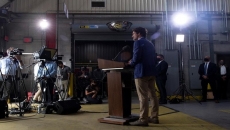
Supreme Court justices pushed lawyers from Saskatchewan and Ontario hard Tuesday, demanding to know how Canada can help stop climate change if any single province chooses not to help.
Two days of hearings have begun in Ottawa to decide three separate appeals related to the federal government's national carbon tax. Since 2019, Ottawa has imposed a federal carbon price on any province that doesn't have an equivalent system of its own.
In 2019, appeals courts in Saskatchewan and Ontario determined the policy was constitutional, while in February of this year the Alberta Court of Appeal said it was not.
The main question is whether the provinces or Ottawa have jurisdiction to regulate greenhouse gases. The environment was not a specific power assigned to provinces or the federal government when the Constitution was signed in 1867, and climate change had not even been contemplated at that time.
Lawyers for Saskatchewan and Ontario argued today, however, that the power does lie with the provinces and Ottawa should not be allowed to nab that power for itself.
Mitch McAdam, the director of the constitutional law branch in Saskatchewan's justice department, said the Greenhouse Gas Pollution Pricing Act, which created the carbon tax program, even says provinces have the ability to regulate greenhouse gases on their own.
Josh Hunter, the deputy director of the constitutional law branch in the office of Ontario's attorney general, said the carbon tax policy gives Canada wide-reaching powers to regulate anything that affects greenhouse gases and treats provinces like subordinates.
"The way they've done it, it's even worse because it's not just they say they're going to regulate it," he told the court. "They say, 'You regulate it the way we like it or we will regulate it.'"
Several judges expressed doubt that Ottawa doesn't have the power to step in when climate change is an "existential" emergency that requires an all-hands-on-deck response from every corner of the country.
Justice Michael Moldaver said "everybody as I understand it agrees that climate change is a serious threat to life on Earth as we know it," and that even if the provinces have the power to do something about it, they don't have to.
"If one province decides not to do it, if one province decides to go rogue, this will have an impact potentially on the whole of Canada, and other provinces that are trying their best," said Moldaver.
Justice Rosalie Abella echoed those sentiments, asking the provincial lawyers to explain what happens if a province doesn't act.
"They can collectively choose to deal with those issues but they don't have Plexiglas at their borders and the effect of not choosing to engage in strategies that are ultimately helpful to the rest of the country has enormous implications," she said. "That's why we have the national concern test."
She told Hunter it was not clear to her yet why Ottawa wouldn't have authority to act just because the provinces could also act.
Abella's comment about Plexiglas comes as all nine Supreme Court justices were separated from each other by space and transparent walls. The carbon tax hearing is the first in-person hearing of the court in the era of the COVID-19 pandemic.
As such, the court is closed to the public, the number of staff in the courtroom is limited, clerks are wearing masks at all times, and the judges and lawyers presenting wore masks until they got to their seats.
Chief Justice Richard Wagner noted the judges are in two rows instead of one now.
The hearing is also being webcast, although the top court has been livestreaming proceedings since before the pandemic.
Federal government lawyers are set to make their arguments defending the carbon tax law Tuesday afternoon, as are lawyers from British Columbia. Alberta lawyers are also on the schedule to argue against it Tuesday.
Wednesday, the hearings will continue with arguments from other provinces, including Quebec, Manitoba and New Brunswick. Also on the schedule for Wednesday are several First Nations and Indigenous governing bodies, as well as more than a dozen special interest groups.