Saturday, May 30, 2026
ADVT 
National

Survey examines hesitancy in early vaccine rollout

Darpan News Desk The Canadian Press, 31 Aug, 2021 03:29 PM
  • Survey examines hesitancy in early vaccine rollout

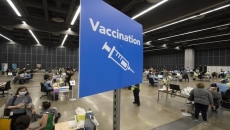
A national survey suggests the vast majority of Canadians planned to get vaccinated against COVID-19 when the country's rollout began, but intentions were lower among certain demographics, including residents of Alberta and racialized communities.

The survey, led by researchers at Toronto's St. Michael's Hospital, was published online Tuesday in The Lancet Regional Health —Americas.

The survey asked more than 14,500 Canadians online between December 2020 and February 2021 if they intended to get vaccinated once they were eligible, with researchers identifying differences in participants by age, education, ethnicity, and home province.

Nine per cent of respondents overall said they did not intend to get vaccinated, with hesitancy highest in Alberta at 16 per cent, and Manitoba and Saskatchewan, both at 14 per cent.

Fifteen per cent of respondents who identified as Indigenous and 12 per cent of those identifying as racialized said they did not intend to get vaccinated.

Men were more hesitant than women overall — 11 per cent versus eight — and participants aged 40 to 59 had the lowest vaccination intention, with about 12 per cent reporting no intention to get vaccinated.

The survey suggested that education also factored into hesitancy, with 14 per cent of participants with a college education or less saying they did not intend to get vaccinated, compared to five per cent of respondents with a bachelor's degree or higher.

The study did not indicate whether intent translated into action, but researchers say they plan to answer that in the coming months.

They noted that 18 per cent of eligible Canadians had not yet received a COVID-19 vaccine dose by Aug. 27 — nearly twice the rate expected in the survey.

Researchers said the findings should encourage policymakers to target vaccine campaigns on the most reluctant groups, as well as those who said they planned to get a shot but did not.

The study was a collaboration between the Centre for Global Health Research at Unity Health Toronto, the University of Toronto and the Angus Reid Forum. Funding was provided by an unrestricted grant from Pfizer Global Medical Grants and Unity Health Toronto.

MORE National ARTICLES

$50M fund to support B.C. anchor attractions

$50M fund to support B.C. anchor attractions
Premier John Horgan and Tourism Minister Melanie Mark said they believe the $50-million BC Major Anchor Attractions Program is enough to prevent any of those not-for-profits and businesses on the edge from going under.

$50M fund to support B.C. anchor attractions

B.C. Mounties say homicide victims were brothers

B.C. Mounties say homicide victims were brothers
The RCMP say they are releasing the names of 29-year-old Erick Fryer and 31-year-old Carlos Fryer in an effort to help their investigation. They say the bodies of the two men from Kamloops, B.C., were found by a couple walking in a remote area around Naramata Creek north of Penticton.

B.C. Mounties say homicide victims were brothers

B.C. may accelerate delivery of second doses

B.C. may accelerate delivery of second doses
In a statement, the province says with a large and steady vaccine supply after most people have had their first jab, officials will be able to consider how they might be able to accelerate the delivery of second shots.

B.C. may accelerate delivery of second doses

Vancouver cops hope DNA might solve boys' murder

Vancouver cops hope DNA might solve boys' murder
Sgt. Steve Addison said advancements in science, in combination with people's interest in learning about their ancestry, have opened a door to discovering who may have killed two boys, ages seven and eight.

Vancouver cops hope DNA might solve boys' murder

B.C. mink farm under COVID-19 quarantine

B.C. mink farm under COVID-19 quarantine
The Ministry of Agriculture says two other mink on the farm, which has about 25,000 animals, are suspected to be positive for the virus. It says in a statement that the quarantine prohibits the movement of animals and materials from the property.

B.C. mink farm under COVID-19 quarantine

Public warning issued against interacting with 11 individuals who pose a significant risk to public safety

Public warning issued against interacting with 11 individuals who pose a significant risk to public safety
Police agencies throughout the Lower Mainland are aware of several conflicts involving numerous crime groups that have resulted in murders and attempted murders in recent weeks in public places. Police are expecting the violence to continue and escalate.

Public warning issued against interacting with 11 individuals who pose a significant risk to public safety