TORONTO — Solomon didn't face a welcoming committee with cameras clicking when he landed in Toronto as a refugee. Instead, he got a send-off.
The smuggler who had brought him into the country gave him a lift into one of the city's predominantly Ethiopian neighbourhoods, wished him well and left him to fend for himself.
With the help of his fellow countrymen, the 16-year-old found his way to a youth shelter, which then passed him off to other community organizations that were largely ill-equipped to help a newly arrived refugee seeking sanctuary in Canada.
His experience stands in stark contrast to the welcome offered to the thousands of Syrian refugees arriving in the country. The earliest arrivals were greeted by none other than Prime Minister Justin Trudeau, who offered them handshakes, hugs and winter apparel.
People fleeing the raging war in Syria went through an accelerated screening process before boarding flights that would take them to a country that has pulled out all the stops for their arrival. The medical care, transportation costs and warm national welcome are all readily available thanks to a Liberal government initiative targeted specifically toward Syrians.
Solomon, who requested that his real name not be used, applauds Canada for offering a helping hand to those fleeing persecution. But he also cautions that Syrians are not alone in facing adversity in their homelands.
"Our (Ethiopian) government has trouble distributing everything to the people," he said in a telephone interview. "Apparently on paper we have what appears to be a democratic country, but when you live there it's totally different."

Differences lie at the heart of the concerns voiced by organizations supporting the thousands of refugees that seek asylum in Canada each year.
While they commend the government's efforts to support a population in crisis, they lament that others in similar circumstances don't have access to the same resources.
Janet Dench, executive director of the Canadian Council for Refugees, fears recent government initiatives have created a two-tier system.
Gaining refugee status in Canada is a complex and bureaucratic process fenced about with rules, quotas and government restrictions.
Dench said many of those barriers have been removed as part of the Syrian refugee resettlement program. The country's sponsorship agreement holders, for instance, are allowed to bring in as many Syrians as they wish while the number from other regions is still subject to government-imposed caps.
Smaller private sponsorship groups, too, are typically only allowed to support those who have been formally recognized as a refugee by either the United Nations High Commission for Refugees or the country in which they were residing when they filed their application.
That lack of recognition was what prompted the then-Conservative government to reject a refugee claim from Mohammad Kurdi, the uncle of three-year-old Alan Kurdi, who drowned along with his brother and their mother when their boat capsized before reaching the Turkish shore. A photo of Alan's lifeless body face down on a Turkish beach is widely credited with galvanizing Canada's efforts to resettle Syrian refugees.

Dench said official recognition is no longer necessary for those fleeing Syria, a fact that she said highlights the disparity between the way other populations are treated during the application process.
"The whole system is really set up to discourage people, and to make it difficult, if not impossible, to sponsor other refugees," she said.
One Montreal church discovered the disparity first-hand after deciding to sponsor a refugee.
John Docherty, pastor of the Menonite Fellowship of Montreal, said the congregation was torn between sponsoring a Syrian family or one from another part of the world where demand is high. The East African country of Eritrea, for instance, is the original home to a third of the world's refugees, according to the UNHCR.
Docherty and his parishioners began looking into the issue and soon encountered a fact that may prove decisive — processing times for non-Syrian refugees are often years longer than for those who are part of the government's current target program.
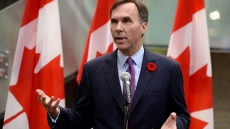
John McCallum, the federal minister of immigration, refugees and citizenship, said the current focus on Syrian refugees has not diverted resources from efforts to bring in refugees from other countries.
"The problem is that the immigration department that we inherited, people have been waiting for years for many things," he said after a panel discussion in Toronto.
"You cannot have any area where there's not a backlog," he said. "One of our major challenges is to reduce those backlogs and to bring down the processing times and that's what we will be doing. You cannot do it overnight."
According to data from Citizenship and Immigration Canada, the average wait time for private sponsorships originating in Africa and the Middle East in 2015 was 45 months, a marked contrast to the quick turnaround expected for the incoming Syrian refugees.

In some visa offices, waits can reach up to 69 months — or just shy of six years.
Docherty said the lengthy wait times are making his group more inclined to direct their sponsorship efforts towards a Syrian family.
"People have energy today that they may not have five years down the road," he said. "The prospect of initiating something now while the enthusiasm is high, the motivation is there, the willingness to pich in and put money up is palpable. Five years from now, that will have evaporated for sure."
Solomon does not see his own more difficult beginnings in Canada as a disadvantage today. He completed high school with a 93-per-cent average and is currently attending Ryerson University on a scholarship.
He believes his initial trials made him "more of a man," adding that the playing field tends to level out for all refugees once the crucial claim documents have been secured and government support tapers off.

"Once you have a good decision about the (refugee) hearing, you don't really care about what you've been through in my opinion," he said. "Paper is the most important thing in Canada. You know, documents. So once you are allowed to have that, you don't care what you've been through because it's only a matter of time to make everything in the right direction."