Canadians are legally allowed to grow, buy and use cannabis – provided they abide by certain regulations.
On October 17, 2018, the Cannabis Act came into effect across Canada, which legalized the use of recreational marijuana. This means adults are legally allowed to grow, buy and use cannabis – provided they abide by certain regulations.
Here are the six most important things you need to know about Canada’s new laws.
1. Only legal adults are allowed to buy, use or possess cannabis
You must be of legal age (as defined by your province or territory) to buy, use or possess cannabis. In British Columbia, the legal age is 19. According to the Government of Canada’s website, legal adults are able to do the following:
> Possess up to 30 grams of legal cannabis, dried or equivalent in non-dried form in public
> Share up to 30 grams with other adults
> Purchase cannabis products from a provincial or territorial retailer You are required to store cannabis away from children, youth and pets.
2. You can grow up to four cannabis plants for personal use
Under the Cannabis Act, adults are allowed to grow cannabis at home for personal use and must not be visible from public spaces off the property. “Each residence can cultivate up to four cannabis plants,” explains Cpl. Elenore Sturko, media relations officer at the Surrey RCMP. “Anyone who contravenes this regulation may be subject to fines.”
In addition, in B.C., home cultivation will be banned in certain dwellings such as daycares. Landlords and strata councils will also be given the authority to restrict or prohibit home cultivation.

3. Legal cannabis will have an excise stamp
To ensure you are purchasing legal cannabis, always look out for the excise stamp on the packaging. “The excise stamp is placed on the product package by the federally Licensed Producer, not by the retailer,” says Hope Latham, public affairs officer for B.C.’s Ministry of Public Safety and Solicitor General. These are stamps that appear in different colours, depending on your province or territory. According to Latham, future stores holding a non-medical cannabis retail license will also have to post their license in a visible place within the store.
“There are currently no provincially licensed private non-medical cannabis storefronts in Surrey, BC,” shares Latham. She clarifies that there is only one government non-medical cannabis retail store in B.C., which is located in Kamloops. To purchase legally, adults 19 and over can visit www.bccannabisstores.com to view the products available online as well as find information on how to use non-medical cannabis safely and responsibly and the risks involved.
4. There are restrictions on where you are allowed to consume cannabis
In British Columbia, adults are able to use non-medical cannabis in public spaces where tobacco smoking and vaping are permitted. However, it is forbidden in any places frequented by children. “Cannabis consumption (in all forms) is banned on K-12 school properties, as well as any adjacent sidewalks or boulevards,” says Cpl. Sturko from Surrey RCMP.
It’s also illegal for both driver and passenger to consume cannabis in a car. “Cannabis consumption is generally not allowed in vehicles whether they are parked or moving, but it can be used in motorhomes or other motor vehicles, or campers, or trailers if it’s being used as a private residence and is parked off a public road or forest service road where camping is allowed.”
Cpl. Sturko also notes that “local and Indigenous governments can set additional restrictions on public use of cannabis under existing powers to establish bylaws.” In addition, landlords and strata councils are able to restrict or prohibit non-medical cannabis smoking at tenanted and strata properties.

5. It is illegal to cross the border with cannabis
Despite the fact that cannabis is now legal and regulated for adults in Canada, it remains illegal to transport cannabis across the Canadian border. You could be subject to criminal charges, even if cannabis is legal in the place you are travelling to. If you are entering Canada with cannabis in any form, you must declare it to the Canadian Border Services Agency and failure to do so could result in arrest or prosecution. It is also important to keep in mind when you’re travelling within Canada that cannabis laws are different between provinces and territories. “The legal age to purchase, possess and consume cannabis and restrictions around where cannabis can be used in public are [some of the] rules that vary across the country,” says Latham. “Specific information on cannabis laws can be found on individual provincial and territorial websites, like under the Travel section of B.C’s website: www.GetCannbisClarity.ca.”

6. Drug impaired driving remains illegal in B.C.
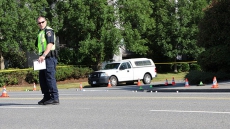
You cannot consume cannabis and drive. Despite cannabis legalization, “drug-impaired driving is, and remains illegal in Canada,” says Cpl. Sturko. “Currently the Surrey RCMP has officers trained to detect, deter, and enforce drug-impaired driving using roadside Standard Field Sobriety Testing and Drug Recognition Expert evaluations.”
Beside being illegal for a driver or a passenger to consume cannabis in a car, there are also laws around the transportation of cannabis. For example, cannabis can be transported in a car only if “it is in its orginal, unopened packaging or is inaccessible to the driver and occupants, for example, in the trunk,” says Cpl. Sturko.
As we enter into a new era of legalized recreational cannabis, it is important to be aware of the laws and regulations. If you’re planning to use cannabis, it is also advisable to know the health effects. “Surrey RCMP would like to remind the public to be responsible in their use of cannabis, please to not drive while under the influence of cannabis, and please do not smoke or vape in areas where it is prohibited,” says Cpl. Sturko.
For more information about the Cannabis Act in BC, visit www.getcannabisclarity.ca for details on the laws and regulations that will help keep the people and communities of British Columbia safe.