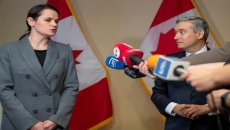
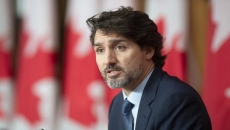
Environment Minister Jonathan Wilkinson appears ready to deal with opposition parties to secure the votes he needs to get his net-zero legislation through Parliament next year.
The proposed legislation would bind Canada to hitting five-year emissions targets starting in 2035, and reaching net zero by 2050.
Wilkinson told The Canadian Press this week he is open to opposition amendments to introduce earlier reporting requirements, within the next decade, to show progress made.
Climate action is how we must rebuild as we look towards the future. It will create good jobs in all corners of this country and ensure our kids inherit a healthy planet. Learn more about Canada’s Strengthened Climate Plan: https://t.co/Z4XhO7QM7J pic.twitter.com/iZKSmSUHGO
— Jonathan Wilkinson 🇨🇦 (@JonathanWNV) December 11, 2020
Actually getting Canada to net zero by the middle of the century will be the hard part.
It will mean finding a way to eliminate or capture more than 24 million tonnes of greenhouse gas emissions annually for the next three decades — about equal to taking five million cars off the road every year.
And all this in a Canada that has been promising to cut emissions for more than 30 years, but has never actually done it.
"It's going to require a lot of effort and a lot of investment. But it is what we need to do to stop global warming," said Taryn Fransen, a senior fellow in the global climate program at the World Resources Institute.
"There is no other alternative."
Reaching net zero involves a combination of eliminating emissions and, where they are still produced, capturing them rather than leaving them to linger in the atmosphere, where they help trap heat and contribute to global warming.
The Paris agreement adopted at the 2015 United Nations climate change conference said avoiding catastrophic global warming requires keeping that as close to 1.5 C as possible, and absolutely no more than 2 C.
The 1.5 C goal requires wealthier and heavier-emitting nations to get to net-zero emissions by 2050. For Canada, that means finding a way to eliminate or capture 729 million tonnes of greenhouse gases over the next 30 years.
The Paris agreement saw Canada commit to getting to 511 million tonnes by 2030. In the five years since that was signed, Canada's emissions actually went up.
Dale Beugin, vice-president of research at the Canadian Institute for Climate Choices, said he is hopeful that this time, Canada's climate action will be real.
"For the first time, federally, we have policies that are consistent with our ambition, with our rhetoric," he said.
Beugin pointed to the $15-billion federal climate action plan unveiled last week, which includes hiking the carbon price and investing in clean energy and zero-emissions technology.
The Pan-Canadian Framework on Clean Growth and Climate Change, introduced in 2016, at best only got Canada two-thirds of the way to its 2030 goal. The new plan, on paper, aims slightly higher, to 503 million tonnes.
In Canada, more than eight in every 10 tonnes of emissions come from burning fossil fuels. That includes driving cars, heating houses, keeping the lights on at work and extracting, refining and shipping the fuels to do it.
Beugin said a net-zero future does not mean changing everything about life in Canada.
"Canadians are still doing what they're doing, they're still moving from one place to another, they're still heating their houses, but they're using less energy to do it," he said.
Some of that involves better-insulated public buildings, helping people afford electric cars and building charging networks to convince people they won't be stranded on the side of the road with a dead battery.
It also means expanding and introducing non-emitting energy sources like hydrogen and nuclear power. Ottawa unveiled a hydrogen plan on Wednesday and a strategy for small nuclear reactors is expected by year's end.
It will also mean major changes for the oil sector, particularly in Alberta. Extracting oil and gas alone accounted for about one-sixth of Canada's 2018 emissions. Shifting to cleaner energy is already happening — coal as an electricity source is being phased out in the next decade, replaced with lower-emitting natural gas, or renewables like hydro and wind.
If coal is still used, its emissions have to be captured and stored, a system already in place at the Boundary Dam in Saskatchewan. The technology is currently expensive and limited, but Michael Bernstein, executive director at the non-profit climate think tank Clean Prosperity, says Wilkinson's plan to more than triple the carbon price between 2022 and 2030 will make it attractive.
Bernstein says hiking the carbon price by the planned $15 a year could get Canada 60 per cent of the way to net zero. Making it expensive to pollute and giving businesses an incentive to invest in pollution-curbing technologies is a "big deal" in the bid to slow global warming, said Bernstein.
The big wrinkle in that plan is politics and the law. Conservative politicians in Canada almost universally loathe the carbon tax. Federal Conservative Leader Erin O'Toole promises to scrap it, and Alberta, Saskatchewan and Ontario have gone to court to stop it. The Supreme Court is set to rule on the matter next year.
Wilkinson's plan to reach the 2030 goal depends heavily on the carbon tax. He says he is confident the court ruling will go his way.
But he says he believes strongly that Canada, and the world, has now passed a tipping point on climate action. Even if there is not total agreement on how to do it, the fights have mostly moved beyond whether anything must be done.
"I just feel like we finally got to the point where we're not pushing the rock up the hill anymore," he said. "We're actually watching it start to go down the hill. And that's exactly the place that, you know, I think we all hoped that we get to."