

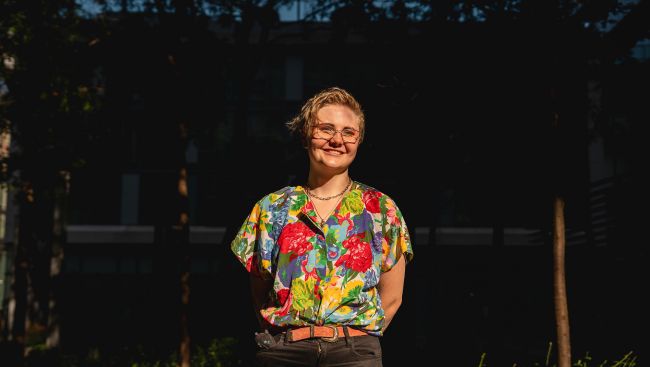
By the time Moira Robertson got an official autism diagnosis at 23 years old, she had missed out on a lot of the government-funded support she desperately needed.
Her childhood and adolescence is marked by painful memories. She stopped going to school after teachers called the police to handle her, and kids peed on her student council posters and publicly declared that something was wrong with her. She wet the bed as a teenager, collapsed into public meltdowns, and felt chronically misunderstood.
Robertson, now 25, grew up in Bruce County, Ont., a 2 ½-hour drive from Toronto, where many of the psychologists and pediatricians who diagnose autism are located. None of the local health providers would diagnose her, and it took five years of waiting to see an out-of-town specialist who finally did.
With so much recent attention on autism, Robertson said she would prefer to shift the spotlight away from the U.S. government's rhetoric – which has focused on finding a cause to what Donald Trump described as a "crisis," and touting an unproven treatment – because it isn’t helpful, and could be harmful.
Robertson, alongside autism advocates in Canada, says what is needed instead is putting more resources into the health-care system to provide people with timely diagnoses, because that can lead to financial, mental-health and educational support.
The master's student believes she missed out on sensory accommodations, social skills supports and neurodiversity-affirming mental-health care.
As an undergraduate, she didn't qualify for funding to cover assistive-listening technology that would have transmitted her professors' voices into a headset, quieting the noise of the lecture hall. She had to fight for accommodations in exam rooms.
Analysis of a Canadian Paediatric Society survey published in 2018 found the wait time from referral to receipt of an autism diagnosis to be seven months, and could take up to two years.
For adults, the average wait time for an assessment is 2 ½-years, according to the Centre for Addiction and Mental Health's website.
Experts and advocates have long called for shorter waits for assessment that could lead to earlier diagnoses, giving patients access to government funded programs at a younger age and earlier stages of development.
Eventually, Robertson said her family caved after years of waiting and paid out of pocket for her to see a private psychologist in Guelph, still more than an hour drive from home.
“Once I finally got the actual piece of paper that is like – yes, she is autistic – boy was that so much easier,” Robertson said.
She qualified for a disability tax credit and her academic accommodations were no longer scrutinized, but she says she missed a lot, both in support and introspection.
"Knowing that I'm autistic and my brain works differently and that means that I struggle with these things and that's OK, is a totally different perspective that I could have taken,” Robertson said.
Though she waited, travelled, and paid, Robertson considers herself luckier than many others.
“I'm a white girl from a middle-class family with two highly educated parents that are still together, and that's why I got the diagnosis. You change any of those characteristics or demographics of mine and suddenly, it might not be there.”
Siyu Chen said her autism diagnosis at 17 years old was delayed, which happens to many women of an ethnic minority. She believes her doctors and teachers in Vancouver didn’t understand that autism might look different in a child with a Chinese background.
“If my parents were able to maybe describe how I was as a child a little bit better, maybe the physicians, the doctors here, could have a better picture of who I was as a person and that could help towards the diagnosis,” Chen said, adding that her parents’ first language is not English.
Chen said what needs to improve is how health providers diagnose women, girls and people from different backgrounds.
In a study published earlier this year, University of British Columbia researchers said up until recently, diagnostic criteria was more sensitive to detecting autism in boys, which could be because most of the research focused on boys and men.
In a U.S. study of national children's data in 2023, researchers found girls were diagnosed a year later than boys — up to two years depending on their racial or ethnic background.
Chen is the interim vice chair of the National Autism Network's board of directors, a group of autistic people and caregivers who will advise the government on how to carry out Canada’s Autism Strategy, the first of its kind in the country, released last year after the Federal Framework on Autism Spectrum Disorder Act in 2023. In the strategy, the federal government placed timely diagnosis as its number 1 priority.
The government invested more than $6.3 million in the network over five years. Chen said this investment shows there is political will to engage with the community, but she’s also pragmatic about the fact that it’s just a starting point.
“The strategy is one of those things where it's a milestone – yes – but those are just words,” Chen said.
“Ultimately doing all of the things in the bill is up to them,” she said, in reference to the government and how it chooses to allocate funding to make its strategy come to life, such as putting money toward developing new autism screening and diagnostic tools.
Provincial and territorial governments are responsible for autism diagnosis and social support, but federal officials can establish guidelines that inform their decisions.
Maddy Dever, who is an autistic parent of four autistic children ages 17, 19, 25 and 26, said the timeline of their family’s diagnoses varied from less than one month to see a private psychologist covered by insurance, to more than six months in the public system.
Dever said one way to cut down on that waiting period is to teach more health providers how to diagnose patients.
They said a program they work with, called Extension for Community Healthcare Outcomes (ECHO), virtually teaches primary care physicians, nurse practitioners, psychologists and pediatricians how to take on that role.
“Giving them the confidence to diagnose would be a big solution. We're doing it,” Dever said, adding that provincial governments need to dedicate more funding to initiatives like this across the country.
A study led by Holland Bloorview Kids Rehabilitation Hospital in 2023 said an increasing prevalence of autism – accounting for about two per cent of children and youth in Canada – has contributed to long wait times, which have likely lengthened since the COVID-19 pandemic. The study found general pediatricians can accurately diagnose autism in children, especially if they feel confident about the diagnosis, and in doing so reduce wait times.
Robertson, who also works with ECHO Ontario Autism, said she was on a virtual educational session when she noticed that her own doctor from her rural hometown who couldn’t diagnose her as a child had joined the call.
That pediatrician now diagnoses kids in Bruce County, Robertson said. She imagined how her life could have been different if she was a child going to that doctor today, with the knowledge and confidence to diagnose autism.
“He probably would have figured it out like the moment I came into the doctor's office,” she said, remembering screaming and refusing to respond to her own name as young as four years old.
“I would have had a diagnosis then and I would have gone through all of elementary and high school and post-secondary and life knowing from the start, and it would have completely changed my life trajectory.”
Picture Courtesy: THE CANADIAN PRESS/Giordano Ciampini


