WASHINGTON - Canada and Mexico will redistribute millions of COVID-19 vaccine doses they received from the United States to other Western Hemisphere countries as a part of today's revived Three Amigos leaders' summit.
Senior U.S. government officials outlined the measure in advance of Thursday's meeting that President Joe Biden is hosting at the White House with Prime Minister Justin Trudeau and Mexican President Andrés Manuel Lopez Obrador.
The officials, speaking on the condition of anonymity as authorized briefers, offered advance details of the American priorities ahead of the first North American leaders' summit since Canada hosted the last one five years ago.
Among those leaders only Trudeau remains, but an initiative that he announced with former U.S. president Barack Obama in Ottawa in 2016 is being revived by Biden — a North American working group on violence against Indigenous women and girls.
The three leaders will also look at strengthening trilateral co-operation on the Western Hemisphere's unprecedented migration crisis that has seen millions of asylum seekers from Central America crashing Mexico's borders while Venezuela's economic and political crisis is expected to produce six million refugees by the end of the year.
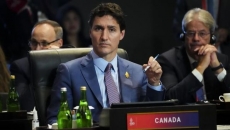
Trudeau and several cabinet ministers in tow, including Deputy Prime Minister Chrystia Freeland, Foreign Affairs Minister Mélanie Joly, Trade Minister Mary Ng and Public Safety Minister Marco Mendicino met one-on-one Thursday morning with López Obrador at D.C.'s Mexican Cultural Institute.
López Obrador, who was meeting Trudeau in person for the first time, described the two countries as "sister nations" in advance of their trilateral meeting with Biden.
"We are both countries that belong in North America," the Mexican president said. "We are countries that collaborate and co-operate."
Trudeau acknowledged that the two countries have "lots of great things to talk about, lots of things that we agree and align on."
One of those is the Biden administration's proposed tax credit for electric vehicles, which Canadian and Mexican officials alike say is a violation of the U.S.-Mexico-Canada Agreement forged as a NAFTA update in 2018.
The credit, which is included in a central piece of legislation that's likely to come up for a vote in the House of Representatives before the end of the week, would provide up to $12,500 in incentives to would-be EV buyers — but only if the vehicle was built in the U.S. with American labour.
Freeland described the proposal Wednesday as potentially "the dominant issue" in the Canada-U.S. relationship if the two countries can't come together on an agreement. In the same breath, however, she said she believes there's plenty of room to negotiate a "win-win" for both sides.
The overarching theme of the summit is joining forces to rebuild after the COVID-19 pandemic and make the North American continent more resilient and self-sustaining against global supply chain bottlenecks.
The plan for Canada and Mexico to share their American-supplied excess vaccines is part of that economic rebuilding plan. When the U.S. loaned Canada and Mexico millions of vaccines there was an agreement that they "would pay those forward" to regional partners, said one official.
The exact details of the distribution are to be worked out later by public health experts, said the officials.
The U.S. officials said that there can be no economic competitiveness without equity and justice, so Biden is keen to forge a continental partnership on racial equity and inclusion.
Biden also wants to engage with Canada and Mexico on dealing with the root causes of the mass migration of asylum seekers south of the Mexican border.
Biden wants "to lock arms with Canada and Mexico" on a joint approach to tackle the economic inequities that are forcing people in the Western Hemisphere to flee their countries in record numbers, officials said.
Given the labour shortages in North America, new approaches need to be found to match economic migrants with potential employment opportunities in the U.S., Canada and Mexico, officials said.
As widely expected, the three leaders will be focused on the supply chain snarls that are hampering the post-pandemic economic recovery.
Canada is expected to be added to the U.S.-Mexico supply chain working group to make it a North American-wide effort aimed at minimizing future disruptions for the continent. The new working group will look at defining essential industries, including critical minerals, officials said.
Trudeau used his first day in Washington on Wednesday to talk up Canada's competitive advantage on critical minerals, which are used in batteries for computers, cellphones, electric vehicles and other essential items.
Trudeau told a think-tank audience that his government began talking with the U.S. two or three years ago about Canada's abundant supply of critical minerals.
China is the world's leading supplier of those minerals but pandemic-induced bottlenecks have created major shortages.